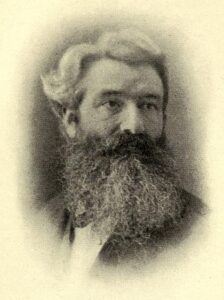
John Weiss (June 28, 1818 – March 9, 1879) was a Unitarian minister, abolitionist, advocate for women’s rights, writer, lecturer, and the earliest biographer of Theodore Parker. Weiss may have been one of the first people of Jewish heritage to affiliate with Unitarianism. Born in Boston, he was the son of a barber also named John Weiss and Mary (Galloope) Weiss. His grandfather was a German Jewish immigrant who first settled in Worcester, Massachusetts.
Weiss has been called brilliant, fearless, and radical. He also had a strong sense of humor. A boyhood story involves a day when he and some other boys spotted a yard filled with cherry trees heavy with ripe fruit. When one of the others suggested they scale the fence and appropriate the fruit, Weiss looked through a knothole and saw the owner nearby, likely to catch them. Rather than be chased and caught, Weiss called out in a loud, virtuous voice that while others might do as they pleased, he was not going to steal a man’s cherries. This clever ploy earned him a reward. The owner admired his honesty and delivered a large basket of cherries to his home.
Weiss attended Chauncey Hall School in Boston, then the Framingham Academy, before entering Harvard College and joining Henry David Thoreau in the Class of 1837. Going on to Divinity School class of 1843, he formed a social group with Thomas Wentworth Higginson, Samuel Johnson and Octavius Brooks Frothingham. He named it the Hook and Ladder Club after he sprayed his companions with a hose. They declared they were holy firefighters putting out devilish fires. Enjoying life and making people laugh remained vital to Weiss throughout his life, as evidenced by his essays on Wit, Humor and Shakespeare (1876), and his delivery of a lecture in New York on “The Cause of Laughter” in February 1873. The New York Times called it a “highly interesting and humorous lecture” that frequently caused “side-splitting laughter” among the audience. Drawing on evolutionary claims that humans had descended from lower animals, Weiss facetiously referred to “the laughing propensity among our [simian] ancestors.”
Before seminary, Weiss taught school in Jamaica Plain. After graduation, he did further study at Heidelberg, Germany (1842-43). He was an outstanding German scholar, editing and translating Henry von Ofterdingen by Novalis, Letters and Essays of Schiller, and Fitche’s Memoir. Some called him a marvelous conversationalist and genius, but he also had the “limitations that are apt to accompany genius.” He could be bitingly critical of others, using bitter sarcasm in his attacks. In one address he noted, “time was that when the brain was out a man would die, but now they make a Unitarian minister of him.”
Weiss was minister twice in Watertown, Massachusetts. His first settlement (1843-1847) was interrupted by conflict over his unswerving abolitionist views, which his congregants found too political. At a meeting in Waltham in 1845 protesting the admission of Texas to the Union, Weiss declared, “our Northern apathy heated the iron, forged the manacles, and built the pillory.” He later wrote: “To say that peace and settlement will result from successive bargainings with slavery, is to say that health results while elements of death prey on the vital power.” Weiss had long felt that things needed to change quickly. “Freedom,” he wrote “is the great interest and central principle of this republic,” and yet the Constitution “turns out to be a slave-whip in the hands of those who live and thrive upon the wrongs of man!” He resigned the Watertown pastorate on October 3, 1845, only to be invited back and return the next year. The slavery issue proved insurmountable in his parish, however, and he resigned again in November 1847 and accepted a call to First Parish in New Bedford.
John Weiss married Sarah Fiske Jennison of Worcester on April 9, 1844, in that city, shortly after settling in Watertown. The early months of ministry, following his ordination on October 25, 1843, were trying. His friend Samuel Longfellow congratulated him “upon my call,” but Weiss found “tedious, nay. . .terrible visiting all through the parish for the first time – the many little trials incidental to the first six months of a settlement.” Yet he could say in the same letter, “I have many delightful friends in Watertown,” and concluded, “The spring is opening – the spring of the year and of my life.”
John and Sarah had two children born in Watertown. The first, Bertha, died at 18 months, but Henry Ware Weiss (b. 1847), survived and flourished. After moving to New Bedford, they had four more: Robert Browning (b. 1848), Charles (b. 1850), Mabel (b. 1854) and Sarah (b. 1856). In another letter to his friend Samuel Longfellow, he wrote “Our little Mabel is a splendor and a delight. – When will you come and see her?” Longfellow lived nearby while serving the church in Fall River, but he left there in 1851, and in 1854 was serving in Brooklyn, New York. Weiss was minister in New Bedford from 1847 to1859.
Joseph Ricketson of New Bedford wrote to Deborah Weston in New York in October 1847 that “we had some of the best preaching I ever heard from Rev. Mr. Weiss of Watertown. The whole audience were taken by surprise. He is not much larger than myself & his voice is feeble but very clear. It can be truly called the still small voice . . . We hardly think of anyone else now but him, he has made such an impression.” Ricketson went on to say that he had been trying to have Weiss preach in New Bedford “for the last six months.” Weiss also gave a lecture for the New Bedford lyceum in October on “a Tour in Circassia,” an area on the northeast shore of the Black Sea. Preaching on a second Sunday convinced the New Bedford congregation that he was their man. He served them eleven years, eventually leaving in 1859 for health reasons.
Probably suffering from tuberculosis, the endemic illness of the age, Weiss appeared “so thin and sepulchral” that Theodore Parker called him a “doomed man.” He supplied the Hollis Street Church in Boston briefly and did some lecturing. According to the 1860 census, he was then living in Milton, teaching languages at Milton Academy. Weiss seemed to blend his tender weakness with spiritual and intellectual strength in the pulpit, so that Cyrus Bartol felt that “among men he was beyond compare.” Others faulted his sermons as abstract and difficult, and found his wit biting and his manner brusque. An opportunity for Weiss to return to Watertown arose during the Civil War when Arthur B. Fuller resigned to become an army chaplain. He was killed at Fredericksburg in December 1862. Weiss then became the minister in Watertown for a second time. His revered predecessor Convers Francis died in 1863, and it fell to Weiss to give the eulogy for his dear mentor.
As the Civil War neared its end, Henry Whitney Bellows, the leading minister from New York City, envisioned a national church organization that would unite religious liberals, just as the nation struggled to build a stronger union. Bellows complained that his fellow Unitarians were “sticklers for individual independence in the churches, and very little disposed to expect great things, or to undertake large enterprises.” In late 1864 Bellows proposed a national conference that might be “a reanimation of our Liberal Xty & its appearance on the public Stage, in National proportions.” This led to the formation of the National Conference of Unitarian Churches, meeting in New York City in1865. The preamble to the organizing documents of the Conference stated that members were “all disciples of the Lord Jesus Christ,” doing the “service of God” by “building up the Kingdom of his Son…” The conference gave the denomination a more solid organizational foundation, but the preamble still defined Unitarianism as within the Christian tradition. Many of the radicals believed that any Christian wording, no matter how broad, still contained the taint of creedalism. Weiss was among them. He did not attend the New York meeting.
When the National Conference met again in 1866 in Syracuse, New York. Francis Ellingwood Abbot, the Unitarian minister in Dover, New Hampshire, brought an alternative preamble, affirming principles of “Love, Righteousness and Truth” instead. After a heated debate, in which some spoke of a rejection of Christ as the head of the Church, the original preamble was reaffirmed. Several ministers left Syracuse feeling as though free inquiry, the bedrock of Unitarianism, had been destroyed. William James Potter from New Bedford, Massachusetts, fumed on the train ride home about starting a “spiritual anti-slavery society.” Weiss, Potter, Abbott and six others met at the home of Cyrus Bartol in Boston in late October. Together they planned to form a Free Religious Association. Weiss was among those who signed a January 1, 1867, letter inviting those interested in such a group to gather at Bartol’s home in February. The founders declared that they were not withdrawing from Unitarianism, so long as it affirmed that each person was free to hold his/her religious convictions, and each church free to manage its own affairs. At the formal organization of the FRA on May 30, 1867, Weiss was scheduled to be one of the principal speakers. Delayed in a Boston traffic jam, he was forced to speak later in the day. He recalled the fight in Syracuse, and how he wanted to see a free non-sectarian organization that would embody both the old and a new, freer Unitarianism.
In their articles of organization, the FRA affirmed a basis broader than anything attempted in previous religious history. Seeking the “common ground on which all religion rests,” the founders sought an “ultimate union…of all religions, Christian and non-Christian.” For the first time, a religious organization proposed that all faiths meet “on perfectly equal terms.” In addition to its openness to what was true in all religions, the FRA advocated the possibility of ever advancing truth without “finality in religious faith and practice.” In its goal of advancing the “pure religion” of Theodore Parker, the FRA was also formed to “encourage the scientific study of theology.” Weiss wished to lead liberals towards a theistic naturalism that embraced both the findings of science and a multi-religious approach to faith. Yet he also wanted free religion to be incorporated into Unitarianism, as that tradition’s proper expression of faith. While the FRA never amounted to much organizationally, its impact on Unitarians and liberal religion was substantial. It embodied a spirit first voiced by Transcendentalists and later embodied in the Western Unitarian Conference as an inclusive practical faith: “love to God and love to man.” While Bellows called Unitarians to institutional vigor, the FRA’s founders asserted a faith that was fiercely individualistic. No one embodied this more than John Weiss.
His concern for reconciling religion and science was not new. In an 1847 sermon, “Faith in God,” Weiss called God a “consummate chemist.” “Our creation is not yet complete,” he said, “In the whole of nature, nowhere can you find a flaw. And the natural world but faintly represents the harmonies of the spiritual.” Yet the impact of Darwin’s 1859 theory of evolution upon his faith was also clear. As Octavius Brooks Frothingham put it, such naturalistic theism “treads the border-land between science and religion, recognizing the claims of both.” In sermons and essays that were called both “poetic” and ‘imaginative,” Weiss’ central affirmation was “divine immanence.”
In 1868, Weiss addressed the graduating class at Harvard Divinity School. He chose to tell the students that religion had failed to respond to science except with old fashioned “Bible-worship” and the like. Weiss described science as showing “the divine method and purpose by means of all animate and inanimate things.” While the listening students applauded such views, the Society for Promoting Theological Education set up a committee to examine the class of 1869 as to their personal views on Christianity, and two were denied their annual stipend. Eventually the matter was resolved in the students favor, but it showed that liberal institutions were still attempting to force the faithful to subscribe to Christianity.
In his most important work, American Religion, Weiss purports that “the idea of God is equivalent to the whole of Life, the whole of History, the whole of Science and Religion.” God is an “immeasurable Presence” who holds “the roots of every sweet or noxious thing,” and, echoing Darwin, he finds people are “like his other growths” who are visited daily by the “tides of his Moral Law.” As with Transcendentalism, Weiss used Kantian epistemology as his starting point, but also affirmed that immanent spiritual truth is grounded in an empirical knowledge of nature: “All the mental states which we call intuitions, should be called digestions from experience.”
Some Free Religionists, such as David Wasson and Thomas Wentworth Higginson, remained loyal to intuition as the basis for faith, while others, including Frothingham and John W. Chadwick, came to prefer purely scientific methods. This caused rancor in the FRA ranks. Weiss tended toward the intuitionists, with Octavius Brooks Frothingham describing him as holding the fortress against “the advancing ranks of the new materialism.” His “theistic naturalism” saw God as an encompassing All with the spiritual world as one and the same as the natural world. When speaking of personal immortality, he said “there is no such thing as death, but an incessant shifting into and out of all forms.” Religion he defined as “the recurrence of human nature to the facts of the universe.” Nature constitutes the basic religious text and is the only religious certitude.
When (he returned) to the pulpit in Watertown in 1862, the Civil War weighed heavily on everyone. That autumn, he gave a sermon he called “A Discourse Upon Causes for Thanksgiving.” In it, Weiss suggested that people should give thanks while embroiled in war since God is present in “every disappointment in our history.” He remained thankful that that truth had been revealed. For too long, he says, people had said that letting slavery alone would result in its dying out and he gave thanks that confronting the issue is “honestly and squarely made at last” rather than lurking within evasive politics. He rejoiced that the President was on the cusp of issuing an emancipation proclamation.
Weiss revered Theodore Parker, whose “Absolute Religion” allowed Weiss and others to reach beyond Christianity to a pure understanding of a divine spirit, accessible and revealed to each soul. This religion of democracy was God’s plan for the world, and each person could feel an “organic fellow feeling” or connection to others, wherever moral or spiritual truth was found. This “one blood of the spirit” would help people embrace a common religious sensibility, but the house for that sensibility necessarily remained undefined. In 1864, he published in two volumes a Life and Correspondence of Parker, preserving many primary materials not found elsewhere.
As an ardent individualist and believer in freedom of religious expression, he declared “the sacredness of the individual is the basis of American Religion.” He feared strong, central institutions. “The soul is weakened by learning to lean upon a go-between.” He declined to attend meetings of the National Conference but also did not want to reject a Unitarian identity. Despite an unwillingness to support a denominational bureaucracy, he served on the Board of Directors of the American Unitarian Association because it was made up only of individuals. Like many of his Unitarian predecessors, he wanted local churches to thrive and be influential, but he emphasized individual faith development and education more than community formation. This did not preclude civic engagement. Quite the contrary.
Near the end of his Watertown ministry Weiss became active in the formation of a new public library in the town. The Watertown School Committee on May 4, 1867, made the “initiatory steps toward the formation of a public library.” Weiss was appointed to a committee to consider establishing such a library, and to report back. Weiss had given a collection of rock specimens he brought from Europe to the local high school and was on the School Committee from 1863-1865, and again in 1867-68. The School Committee became convinced that it was important to establish a Free Public Library. During the preliminary town meeting on June 6, 1867, held in the vestry of the Unitarian Church, the idea of a library was unanimously approved, and a committee appointed to raise funds. The library records state: “The meeting was addressed by the Rev. John Weiss in favor of the establishment of a town library.” When the Committee met in December, Weiss was late, but once he had entered the meeting, he “suggested that it would be well to propose some plan of action and some statement of the kinds of books which would be of use in a community like ours.” On January 28 a committee was appointed to form a plan of organization with Weiss as chair. Six months later, the town approved rules and regulations, and the appointment of the first library Board of trustees, with Weiss as chairman, a position he held for only one year (1868-69), although he continued as a Trustee until 1872. The Board met for the first time on July 28, 1868 at Weiss’ home. On March 31, 1869, the Free Public Library opened on the first floor of the town hall (an old dry goods store). The First Report of the Library said that Weiss “gave largely from his own library and his wide knowledge of literature was an invaluable aid in the excellent choice of books which were purchased as the foundation of the library.” After Weiss had resigned from the Watertown church in 1869, the records show that on January 1, 1871, it was “unanimously voted to present to the public library of the town the parish library belonging to the church members of the First Parish.”
Solon Whitney, a fellow trustee, observed that his efforts had to overcome sectarianism: ”John Weiss, looking up to the spire of one of the churches and thinking of the exclusiveness which in the name of religion bars out all who cannot pronounce a certain shibboleth, was moved to say that the time will sometime come when the work of the public library will be sustained with hope and with honor when all such narrowness shall be despised and forgotten. With the keen eye that looks through shams and the clouds that beset ignorance and selfishness he saw with that piercing vision the weakness in the harness of other men, while feeling with humility the mortal weakness of his own.” He concluded that John Weiss represented the “the keen eye, the facile tongue, the wise leader.”
During Weiss’ ministry in New Bedford, the church there ceased to exist as an entity separate from the parish, so there was no longer any semblance of creed or even covenant that members had to embrace. This meant that the doors were open to anyone – atheists, Buddhists, Jews, etc. – who wished to join. This emphasis upon complete freedom provoked attacks for years to come. Weiss was an officer of the FRA in 1872 when the official Unitarian periodical, the Christian Register, stated, “the Free Religionists stand before the world as an anti-Christian sect.” The AUA threatened to withhold hospitality because anyone who united with the FRA was “virtually renouncing Christianity.”
When Frothingham spoke before the FRA in 1876, he reminded the gathering that no one was truly free unless they saw the opposition’s point of view, but Weiss responded that he could not forget the ever-present conflict between freedom and organized religion, and he always remembered that religion could oppress. Weiss’ embrace of the sacredness of the individual and his/her freedom made it difficult for him to believe in any structure that might impede freedom. His distaste for limits or rules precluded the idea that fulfillment might be interpersonal, not wholly individual. “America is an opportunity to make a Religion out of the sacredness of the individual,” he wrote, and his American Religion was embodied in democracy, which affirmed a kind of total embrace of each person’s ability to know the truth.
After his active parish days had ended, Weiss met Minot Savage, a minister devoted to the new Unitarianism, on the street in Boston. He reminded him how radicals had been attacked. He said, “Savage, you ought to be grateful to some of us fellows. We have been killed to make way for you.” The last ten years of Weiss’ life were spent writing and lecturing. He was a member of the Radical Club, which met on Chestnut Street in Boston and was designed for the free investigation of all forms of religious thought and inquiry. Its first meeting was in 1867, with thirty people present. Various denominations were represented. The last meeting in 1880 had two hundred in attendance. Members presented papers, and others responded to them. Weiss’ major papers were on: “Immanence of God,” “Woman,” “Music,” “Heart in Religion”, “Fatality” and “Constancy to an Ideal.”
A report on his delivery of “Woman” in Sketches and Reminiscences of the Radical Club by Mrs. Mary (John T.) Sargent reveals some of Weiss’ impact. His paper began with a witty statement of the imperfections of our present political machinery, satirizing the attempts which men have made to give a monopoly of the regulations of public affairs to the rougher and coarser half of the human family. Weiss predicted that women “should combine with men in political, not less than in domestic arrangements.” They should have a right to such an equal partnership, he said, but seemed to express that a speedy, if not “immediate change for the better” would take place in “state and national politics as soon as women should assist in directing them.” Mary Sargent said that trying to report on this essay was like trying to describe “Beethoven’s heroic symphony.” “Everyone felt that the best had been said, and there was nothing left but silence.” Emerson said that a spell had been put upon the audience.
Yet Weiss’ ability to cast political and religious spells had come to an end. He died on March 9, 1879. The Radical Club disbanded a year later. Frothingham once wrote of Weiss, “He was a flame of fire. He was genius, unalloyed by terrestrial consideration; a spirit lamp, always burning.”
Article by Mark W. Harris
Published August 6, 2026
Sources:
Diaries and Correspondence of John Weiss are in the Belcher, Jennison and Weiss papers at the Massachusetts Historical Society. Correspondence, 1839-1894, American Antiquarian Society, Worcester, MA. Correspondence between John Weiss and Samuel Longfellow, Longfellow House, Cambridge.
His most substantial book was American Religion (1871). He was perhaps best known for his Life and Correspondence of Theodore Parker, 2 vols. (1864). Other publications include: The Aesthetic Letters, Essays and Philosophical Letters of Schiller, Translated with An Introduction (Boston, 1845), Wit, Humor and Shakespeare: Twelve Essays (Boston, 1876), Goethe’s West-Easterly Divan, Translated with Introduction and Notes. (Boston, 1877), The Immortal Life (Boston, 1880). See also, John Weiss, “Religion and Science,” The Free Religious Association, Freedom and Fellowship in Religion, and John Weiss, “Discourse Occasioned by the Death of Convers Francis, D.D.” (Cambridge, 1863). Many poems were published in The Radical. Numerous sermons, reviews, essays, and lectures were also published.
There is no standard biography of Weiss. He receives brief treatment in Samuel A. Eliot, ed., Heralds of a Liberal Faith, vol. 3. pp. 376-380 and in Octavius Brooks Frothingham’s Transcendentalism in New England (University of Pennsylvania Press reprint, 1959), and Philip Gura’s American Transcendentalism: A History (Hill and Wang, 2007). See also Dictionary of American Biography, Charles Scribner’s Sons, New York, 1936, Vol. 10, Pt. 1, p. 615. See also: David M. Robinson, “The New Epoch of Belief: The Radical and Religious Transformation in Nineteenth Century New England,” The New England Quarterly (Dec 2006) LXXIV, No. 4.