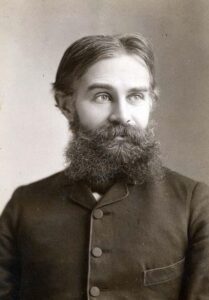
 William Channing Gannett (March 13, 1840-December 15, 1923) was a Unitarian minister, biographer, newsletter editor, poet, hymn writer, Western Unitarian Conference leader, and social reformer who was active in the abolitionist, temperance, and women’s suffragist movements. He is perhaps best remembered for his many enduring hymns, including “Bring, O Morn, Thy Music,” “The Morning Hangs a Signal,” and “It Sounds Along the Ages.” He helped to resolve the division between Christian and post-Christian Unitarians in the Western Conference with his 1887 statement, “Some Things Commonly Believed Among Us.”
We believe that to love the Good and to live the Good is the supreme thing in religion;
- We hold reason and conscience to be final authorities in matters of religious belief;
- We honor the Bible and all inspiring scripture, old and new;
- We revere Jesus, and all holy souls that have taught men truth and righteousness and love, as prophets of religion;
- We believe in the growing nobility of Man; We trust the unfolding Universe as beautiful, beneficent, unchanging Order; to know this order is truth; to obey it is right and liberty and stronger life;
- We believe that good and evil invariably carry their own recompense, no good thing being failure and no evil thing success; that heaven and hell are states of being; that no evil can befall the good man in either life or death; that all things work together for the victory of the Good;
- We believe that we ought to join hands and work to make the good things better and the worst good, counting nothing good for self that is not good for all;
- We believe that this self-forgetting, loyal life awakes in man the sense of union here and now with things eternal—the sense of deathlessness; and this sense is to us an earnest of the life to come;
- We worship One-in-All — that life whence suns and stars derive their orbits and the soul of man its Ought, — that Light which lighteth every man that cometh into the world, giving us power to become the sons of God, — that Love with which our souls commune.
Gannett descended from a long line of ministers, notably his grandfather, Rev. Caleb Gannett, and his father, Rev. Ezra Stiles Gannett, who was one of the founders of the American Unitarian Association (AUA), the first secretary, and later its President. The elder Rev. Gannett was associate minister at the Federal Street Church of the Rev. William Ellery Channing, by whom his son was christened and given his name. Gannett’s mother, Anna Tilden Gannett, likewise descended from a strong religious heritage as her grandfather, Deacon William Brown, was a Bible salesman and itinerant preacher in New Hampshire. William Channing Gannett grew up in the center of elite Unitarian religious leadership. This background clearly influenced his life, but did not determine his beliefs, as he considered himself more liberal and radical than the dominant group of Unitarian elites of Boston during the 19th century.
Gannett began studied architecture as a Harvard undergraduate in the Class of 1860. He then taught for a year in Rhode Island. Uncomfortable as a teacher, Gannett returned to Boston and entered Harvard Divinity School in 1861. Still unsatisfied, he left after a single semester to teach freed slaves living on the Sea Islands of South Carolina and Georgia in what is known as “the Port Royal Experiment.” He was a member of the first group of teachers and assistants sent by the New England Freedman’s Society, seeking to demonstrate that, contrary to the stereotypes of the times, African Americans would flourish in their work if only provided educational opportunities. He spent four years there, teaching the first year, then serving as superintendent of up to 13 plantations of the project at a time. In this role, he helped establish basic housing infrastructure for freedmen, and was responsible for making the plantations he supervised economically productive. During these formative years, working with women volunteers such as Charlotte Forten Grimké, Louisa May Alcott, and others, Gannett further solidified his strong, principled anti-racist worldview, appetite for social reform, and strong liberal views on not only race, but also gender and religious liberty.
After four years, he returned to Boston to attend to his ailing father, re-enrolling in Harvard Divinity School, and graduating in 1868. His first called ministry was to the Unitarian Church of Milwaukee (1868-1870), where he continued to push for social reforms. There he became active in the women’s suffragist movement, befriending Elizabeth Cady Stanton and later Susan B. Anthony. Gannett served as a vice-president of the Wisconsin Women’s Suffrage Association in 1869. Wisconsin eventually became the first state to adopt the federal constitutional amendment granting suffrage to women in 1919. (Unfortunately, the state failed to grant women the vote in state elections until 1934).
In 1871, Gannett resigned his post in Milwaukee to spend more time with his ailing father, who died later that year. He served as minister of First Parish Unitarian Church in Lexington, Massachusetts for two years. One of Gannett’s accomplishments during this period was a meticulous memoir of his father’s life. He covered not only his father’s life, but also the history of the Unitarianism and creation of the American Unitarian Association (AUA) in Ezra Stiles Gannett: Unitarian Minister in Boston 1824-1871. Gannett reviewed important players and offered critical reflection on Christian and Unitarian theological evolution. He remained in Lexington after leaving his pastorate, publishing this work in 1875 and beginning several others.
In 1877, he headed west again to lead another young congregation, the Unity Church of St. Paul, Minnesota. Gannett was a self-proclaimed “radical” and far more liberal than his father. He was staunchly anti-creedal. Upon graduation from Harvard, he had joined the newly formed Free Religious Association (FRA) for a time, and in the Western Unitarian Conference (WUC) became the voice of the more liberal wing of Unitarianism. When Gannett received the call to Unity Church, he advised the membership of exactly whom they were asking to hire as their minister. He responded frankly to Joseph Sewall, the chairman of the Board of Trustees, noting “You invite one unlikely to add to your numbers … one, too, who can neither offer the Communion Service nor claim the ‘Unitarian’ or even the ‘Christian’ name and who could attend your conferences only by the right of hearty interest, not of membership.” He warned the congregation that their reputation within the Association might suffer if they hired him, and that no financial support for him or his ministry could be expected from the AUA. He underscored that “[i]t is understood here [in Boston] that one like me is fairly outside the denomination.”
While at Unity Church, Gannett became active in the Sunday School program. Unsatisfied with the lessons published from the AUA, he began writing original lessons and making copies to sell to other Unitarian Churches. He promoted social clubs at the parish, including the Unity Club (organized in 1877 for education and social purposes), the Lend a Hand Club (helping to distribute Thanksgiving meals), and True Helpers, a club for children connected to the Temperance Society. In addition, he provided strong support for the Ladies Benevolent Society who helped the poor by providing them with both clothing and work opportunities.
On March 2, 1879, Gannett requested ordination from Unity Church, which was secured a month later. For this ceremony, Gannett developed what he dubbed an “agreement” but which others might call a “covenant.” Non-theistic, it was one of the first of its kind, it is still used today. It reads as follows:
As those who believe in Religion,
As those who believe in Freedom, Fellowship, and Character in Religion,
As those who believe that the religious life means the thankful, trustful, loyal, and helpful life,
And as those who believe that a church is a brotherhood of helpers wherein it is made easier to lead such a life,
We join ourselves together, name, hand and heart as members of Unity Church.
Note the lack of any mention of Christianity or even the name of Jesus. Gannett felt strongly that anyone who espoused the same values, attitudes, and ideals of social progress might be full members of Unity Church and rightly call themselves Unitarians. When accused of trying to remove God from the Unitarian church, Gannett argued the opposite—that he was not narrowing the foundation of solidarity and community but rather broadening it. He was not in favor of excluding Christians but was in favor of including those who were not. Gannett aptly summed up this sentiment as follows: “Whoever loves truth and the lives the Good, in a broad sense of our religious fellowship, whoever loves the one or lives the other better than ourselves is our teacher, whatever church or age he may belong to.”
Gannet’s dedication to his liberal views brought him to focus on the politics of the Unitarian Church and the AUA. In 1883, after 11 years in congregational ministry, he resigned his post at Unity Church in St. Paul and for six years served as Minister at Large for the Western Unitarian Conference. Founded in 1852, the WUC leadership gradually became open to individuals of various strands of personal belief and more liberal than the Boston dominated AUA. By 1875, the WUC had adopted a resolution stating that it “…conditions its fellowship on no dogmatic tests but welcomes all thereto who desire to work with it in advancing the kingdom of God.” Gannett soon became a leading voice of liberal advocates as tension grew among the AUA, the WUC, and the newly founded Western Unitarian Association (WUA). The latter organization served as the conservative counterweight to the WUC in the west, as led by Gannett’s rival Rev. Jabez T. Sunderland of Ann Arbor, Michigan. The tension and politics of these three entities and the personalities who led them remained the focus of much of Gannett’s time and energy throughout the next twenty years. Through the Unity newsletter that he and four others founded, Gannett constantly pressed the issue of being open to members of many understandings of God, including those who not only reject the trinity, but who can no longer call themselves Christians per se. The conservative WUA pushed its position of demanding a minimal creedal position of belief in Christianity while the WUC remained open to all individuals willing to accept the principles and ethics of the conference rather than dogma and doctrines.
The WUC and WUA adopted dueling resolutions at their respective conferences over the next few years. The AUA avoided choosing sides for fear of losing a large number of congregations in the west precisely at a time when it was seeking growth. At times it appeared that members of the WUC, including Gannett, would advocate a split from the AUA altogether. Many of his adversaries challenged Gannett on his liberalness and openness, arguing that if everyone can be welcomed into the Unitarian movement, then it essentially stands for nothing. Gannett’s “Some Things Commonly Believed Among Us” was affirmed at the 1887 WUC meeting in Chicago by a vote of 59 to 13. Its list of eight bullet points underscored the central role of humanity in determining good and right action, and in creating loving social relations in this life rather than focusing on the life to come. In this process, the Bible and the story of Jesus are accepted as inspirational, but the use of reason and the right of individual conscience are final authorities of religious belief. He made clear, however, that this list in no way constituted a minimal set of doctrines that one was compelled to confess. It was simply what a majority of those who call themselves Unitarians profess. In doing so, at this and other key moments, Gannett found a way to remain in the Unitarian fold rather than traverse a formal split. When invited to join the AUA Board of Trustees at one point, however, he declined.
In 1887, Gannet also accepted a call as minister of the Unitarian Church of Hinsdale, Illinois. There he married Mary Thorn Lewis, who became not only his life partner, but also co-author of a book of prayers for children and his confidante in matters of social reforms. They had two children while in Hinsdale, moving two years later to Gannett’s final ministerial position as pastor of the Rochester Unitarian Church in New York.
Gannett continued his active involvement in the Western Unitarian Conference while in Rochester, but also became involved in local social reforms. Notable was his attempt to set up an evening club for boys of all faiths. Over the course of his tenure in Rochester, the Boys Evening Home (BEH) grew from a simple after school program with a few classes, arts and crafts, and a safe environment to socialize to include classes on “spelling, penmanship, history, zoology, physiology, geography, literature, natural history, and journalism.” Over two hundred boys were frequenting the club at its zenith in the early 1900s.
Gannett was a strong supporter of women’s rights throughout his life, and especially while he served in Rochester. Susan B. Anthony was a congregant of the Rochester church, and he supported her in several ways. He assisted Anthony, for example, in expanding university education to women at the University of Rochester in 1900 by helping to provide the gap in fundraising required by the Board of Trustees to make the policy change. He also supported reforms to the Rochester School Board of Education that allowed the first woman to be elected. Finally, he strongly encouraged the growth of women’s associations at the church and ecumenical efforts to organize women in Rochester.
Gannett was a prolific writer in areas that supported his theological, philosophical, political, and social viewpoints. He wrote poetry and prayers for use in the home. William and Mary Gannett together created and later published a set of 31 morning prayers for children entitled The Little Child at the Breakfast Table. He published a widely used hymn book with hymns that inspired members from various doctrinal positions. Gannett even inspired the architect Frank Lloyd Wright to design a book, The House Beautiful, from an essay he wrote.
Gannett published several of his sermons either as pamphlets or with other minister friends in collections. As editor of Unity newsletter, Gannett had a strong influence over the theological path of the Unitarian movement, especially with respect to maintaining a liberal outlook based on principles and ethics in contrast to theological doctrine. Beyond the biography of his father, Gannett provides another significant historical overview of Unitarianism in a sermon he offered at the 50th anniversary of the Unitarian Church in Germantown, Pennsylvania. Entitled A Hundred Years of the Unitarian Movement in America, 1815-1915: the Story, the Difficulties, the Outlook, Gannett not only offers a review of Unitarian history, but also discusses two major difficulties confronting the movement. The first is the lack of three elements necessary in fostering interest in the movement: a lack of poetry, a lack of feeling, and a lack of religious experience. Gannett argued that Unitarians rely so heavily on their rational approach to faith that they miss other important elements of what people seek when they seek out religious fellowship. Gannett exhorts Unitarians ministers to pay attention to the emotive and personal experiential elements of faith and religious community. Second, he notes the strong growth of evangelical orthodoxy in the US, and how it attracts followers who only timidly question the traditional interpretations of the Bible and other authoritative sources. Thus, he suggests that the Unitarian denominational outlook will improve only if the leadership pays attention to the deficiencies of what Unitarian has offered to date and adjust accordingly.
In all his writing, Gannett was dedicated to bringing religion and science together—not allowing his own rationality (which he claimed must be a divine gift if anything should be considered divine) to be trumped by uncertain pre-scientific ideas from – scriptures or church authority. Indeed, he appeared to marry them as he stated, “We have claimed Science for Religion and Religion for Science. We have declared the secular sacred, the material spiritual, and the natural divine.” The final resolution of the so-called Western Issue came in the wake of the first 1893 meeting of the World’s Parliament of Religions with its unique calls for religious tolerance, acceptance, and inter-religious dialogue. If the leaders of the world’s religions could call for unity, how much more so the Unitarians? The 1894 Saratoga Convention proposed somewhat contradictory language for the new constitution of the National Conference of Unitarian and other Christian Churches. The Preamble declared that the churches “…accept the religion of Jesus, holding … that practical religion is summed up in love of God and love to man.” Simultaneously, however, Article 8 stated plainly “… that nothing in this constitution is to be construed as an authoritative test; and we cordially invite to our working fellowship any who, while differing from us in belief, are in general sympathy with our spirit and our practical aim.” Gannett saw this final declaration as a great victory for the Western Conference and for liberalism. Without a doubt, this affirmation continued to shape the later path of American Unitarianism.
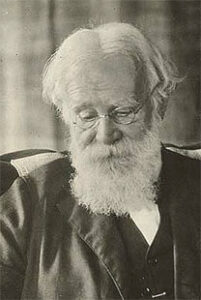 In retirement, Gannett remained active as ever in promoting social justice causes and movements. One striking example occurred only two years before he died. In the fall of 1921, three of five Black incoming students applied for a housing assignment in the Freshman dorm at Harvard University. Living in the dorm was mandatory for all first-year students. While two of the students’ application was rejected (they were assigned to other dorms), the third, from William Knox, Jr., was accepted until he showed up for a college visit and thus revealed his race. Knox soon received a postcard saying he could not stay in the Freshman dorm, but was assigned to a different residence hall. When a friend demanded an explanation, then President Abbott Lawrence Lowell explained that Harvard was receiving many more students from the South, and that the situation created tension in the Freshman residence hall. The solution was to exclude Blacks from the dorm to avoid mandating that white southerners share a dormitory (much less a room) with a Black person.
Gannett led the effort to both expose the practice and rally other Harvard alumni to sign on to a letter demanding the revocation of this policy. They argued that Southerners coming to Harvard had to adjust to Northern norms and not the other way around. The letter stated in part, “We believe the University owes the Southern man the best possible opportunity for education, but we do not owe him the surrender of our Northern ideas of democracy and our Harvard ideals of justice. We do not believe the southerners who come to Cambridge for their education expect Harvard to give up their traditions.”
The controversy spilled out onto the pages of the New York Times the following year when a letter from Lowell trying to explain the “reasonableness of our position” appeared. The controversy continued throughout the spring, finally landing at the college’s Board of Overseers who adopted a new policy in April of 1923. That body stated that “…all members of the freshmen class shall reside and board in the Freshman Halls… In the application of this rule, men of the white and colored races shall not be compelled to live and eat together, nor shall any man be excluded by reason of his color.” Unfortunately, the discrimination continued, and in 1926, a new requirement that a passport photo accompany every application made it possible. According to historian Arthur Schlesinger (2005), this racial discriminatory practice continued at Harvard until the 1950s.
Gannett served the Rochester congregation for 19 years as minister before retiring and becoming Minister Emeritus in 1908 at the age of 68. He died on December 15, 1923, and was cremated and buried in Rochester. He had a strong impact on the evolution of the Unitarian movement, and many of his ideas of forming a unified church that speaks to people of many differing beliefs as they search for truth and meaning in their lives continues to be reflected in the modern day Unitarian Universalist movement.
Article by Ron Ahnen
Published November 16, 2026
Note on Sources: The most complete set of sources for William Channing Gannett are the “William Channing Gannet Papers” collection of 75 boxes of his written works, correspondence, photos, and personal papers housed at the River Campus Libraries of the University of Rochester, New York. (https://rbscp.lib.rochester.edu/finding-aids/AG18). In addition, the Online Books project of the University of Pennsylvania makes several editions of his most important works available online (https://onlinebooks.library.upenn.edu).