Founded in response to the 1866 meeting of the National Conference of Unitarian Churches in Syracuse, New York, where the congregational delegates reaffirmed allegiance to Jesus Christ, the FRA was initiated by radical Unitarian ministers who had failed to convince the group to declare itself nonsectarian or organize to include independent congregations as well as Unitarian. On the trip back to New Bedford, Massachusetts, William J. Potter began to ruminate on the idea of creating a new organization which would promote complete spiritual freedom from irrational doctrines and traditional authorities.
In October eight ministers met at the Boston home of Cyrus Bartol, all inclined to revolt from the Unitarian conference, and perhaps to organize a new denomination. Two additional meetings were held. A group headed by Potter, Edward C. Towne and Francis Ellingwood Abbot drafted a constitution for the new Free Religious Association. The majority of the 30 people present wanted a new group, but they did not want to break fully with Unitarianism. Finally, an organizational meeting was held in Boston on 30 May 1867.
This initial public gathering drew a large audience to hear several speakers, including Ralph Waldo Emerson. Abbot said free religion was a transfer of loyalty from Christ to Christ’s principles: truth, righteousness and love. The new faith was meant to reconcile religion and science. The constitution was adopted calling for an association that would: “promote the interests of pure religion, to encourage the scientific study of theology, and to increase fellowship in the spirit.”
Octavius Brooks Frothingham was the first president of the FRA, but Potter was the driving force behind the organization for many years. He conceived of the organization as a group that extended a welcome to all religions. In 1872 he helped add an amendment to the constitution that no form of theism was required for members.
Historian Stow Persons said that the FRA became little more than a debating society as the group moved away from establishing a new religion to fit the needs of a rationalistic age, and instead placed emphasis on the universal, nonsectarian aspects of free religion. Unfortunately, the constitution did not allow the group to speak as a united front since members were only responsible for their own opinions, and there were no restrictions upon their connection with other organizations. The executive committee agreed that using tracts and lectures were appropriate means for spreading the word that a universal religious feeling was shared in all religions, but when they tried to organize meetings to show that there was such a thing as absolute religion, they usually found religion expressed in contrary ways with sectarian opinions. The FRA sponsored regular lecture series which continued until 1878.
Secretary Potter corresponded with many other religious groups throughout the world, but again the promotion of complete freedom prevented the group from joining with others to promote pure religion. After 1880 the group tried to root out some of this extreme individualism, but they failed. Potter remained the most influential member until his death in 1894.
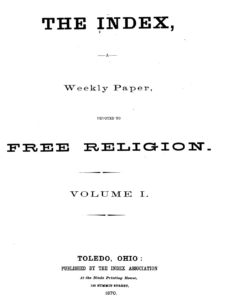
The FRA’s periodical was called the Index. It was established in 1870 with Abbot as its first editor, after he had gone to Toledo to serve the church there, which dropped its Unitarian connection and became an independent society. David Locke had offered to finance a weekly journal of free religion, and the Index was the result. The first few issues included Abbot’s “Fifty Affirmations,” which stated that free religion was the final form of religion. After 10 years Abbot gave the Index over to the FRA to publish, and Potter became one of its editors.
The FRA also held annual conventions which included public meetings and lectures. After 1894 the group decided to have local chapters, but by then it was too late for organizational improvements, and the organization never numbered more than 500 members. Little organizational activity was ever carried out in a group which hallowed the individual beliefs of its members so much.
The FRA lived on into the 20th century, but its effectiveness as an organization was largely restricted to the last two decades of the 19th century. In addition to its organizational problems around freedom, the group was sometimes identified as an anti-Christian cult. What may have been most deadly, however, was its identification with immorality. Pornographers tried to use Abbot’s Liberal League to have the Comstock Laws repealed, and this prominent member of the FRA became associated with free love and infidelity. While never a success organizationally, the FRA had a profound influence in transforming Unitarianism into a broader, more universal and humanistic faith.
Article by Mark W. Harris
Sources: The only major study of the FRA is Free Religion: An American Faith by Stow Persons, New Haven: Yale University Press, 1947. Biographies of some of the major leaders of the movement have been published. These include: Wade J. Carruthers, Octavius Brooks Frothingham: Gentle Radical, Montgomery: University of Alabama Press, 1977 and Sidney Ahlstrom and Robert Bruce Mullin, The Scientific Theist: The Life of Francis Ellingwood, Abbot, Macon, GA: Mercer University Press, 1987. Important shorter articles include: “The New Epoch of Belief”: The Radical and Religious Transformation in Nineteenth Century New England by David M. Robinson, New England Quarterly (December 2006) and “The Free Religion Movement” by David M. Robinson, Oxford Handbook of Transcendentalism (2010). Scholars should also consult primary materials including sermons by the active members of the FRA, and two journals including their principal publication: The Index, and also The Radical.