
English-born Frances Anne (Fanny) Kemble (Nov. 27, 1809 – Jan. 15, 1893) lived a dramatic life on both sides of the Atlantic as an actress, abolitionist, and writer. She is best known for her controversial Journal of a Residence on a Georgian Plantation 1838-1839, published only in 1863. Written as letters to fellow Unitarian Elizabeth Sedgwick, the Journal depicts Kemble’s life among Black women and men enslaved on properties inherited by her husband. In it, she claimed that when she married him in Philadelphia in 1834, she did not know him to be an enslaver. She left him, and the couple had a contentious divorce in which she lost access to their two children. Having long earned her livelihood on the stage, Kemble hoped that her legacy would be through her writings.
Born into Britain’s best-known theatrical family, one that strived for respectability, Fanny Kemble was sent to a boarding school in Paris for her education. Her moral concerns were expressed there by writing weekly sermon-essays on Biblical texts. She even wrote such assignments for less religiously inclined classmates. She was not destined for the stage until her father’s failed management of Covent Garden Theater required a bold solution. She debuted as Juliet in 1829 and won such success in that and other roles that she and her father undertook an American tour beginning in 1832. At the White House, she had the temerity to challenge President Andrew Jackson about the removal of Indigenous peoples. His reply was that the issue began “in no large a source than the nib of a pen of a lady.” Kemble said in her Journal, “if this be true, the lady must have scribbled to some purpose.”
On tour, Kemble met the Sedgwick family, including novelist Catherine Sedgwick. They in turn introduced her to William Ellery Channing, whose printed sermons and essays she had read even before coming to America. At their first meeting, Channing shocked her by saying that Shakespeare’s plays were suitable for drawing room readings. Ironically, semi-public readings of the Bard’s works later became principal source of her income.
When they played in Philadelphia, her father introduced her to a wealthy young man who admired her. Pierce Mease Butler (1810-1867) was the son of Dr. James Mease and Sarah Butler Mease, members of First Unitarian Church. On turning 21, he had changed his name to that of his maternal grandfather, Pierce Butler (1744-1822). A member of the U.S. Constitutional Convention and an inaugural U.S. Senator from South Carolina, the elder Butler had accumulated an enormous fortune made through his plantations on the Sea Islands, extending into Georgia. Pierce and his brother were to inherit those possessions on the death of their aunt. When Fanny and Pierce were married in 1834, it was at historic Christ Episcopal church, since Fanny was still an Anglican, as had been his grandfather Butler.
The couple soon began attending services led by the Unitarian minister in Philadelphia, William Henry Furness (1802-1896), who was a protégé of Channing. The Butler home in the suburbs was near to that of Furness, and the two families had often visited one another. Furness remarked in a letter written after meeting Fanny that “it would be impossible to suppose from her manners that she had ever appeared on the stage.” She came to refer to him as “my dear and venerated spiritual pastor.” After the British Emancipation Act of 1833 and Channing’s 1835 book, Slavery, Furness often discussed the abolition of slavery. When he gave his first public abolitionist sermon, in 1839, Pierce Butler was sitting in a front pew.
Fanny, in an 1835 letter to lifelong friend Harriet St. Leger, declared that at the Unitarian church she heard “admirable instruction and exhortation, and eloquent, excellent preaching, that does my soul good.” She described Unitarian clergy “as among the most enlightened and cultivated men I have met within this country.” Of Channing’s Slavery, she called it, “like everything else of his, written in the pure spirit of Christianity, with judgment, temper and moderation, yet with abundant warmth and energy.”

A week after the birth of her daughter Sarah, on May 28, 1835, Fanny became a “scribbling woman” with the publication of her Journal of Frances Anne Butler. Princess Victoria herself read it. Although finding it at first “full of trash and nonsense,” she later confessed, “I read in Mrs. Butler’s journal which amuses me. There are some very fine feelings in it.” Fanny had also written an abolitionist treatise she wanted to accompany this first Journal but feared the violence then prevalent against known abolitionists and acquiesced to her husband, who opposed her publishing at all. After the birth of a second daughter, Fan, in 1838, the young Butlers spent the winter of 1838-39 on Butler Island, Georgia, living in the modest house normally occupied by the plantation’s overseer.
Fanny’s letters to Elizabeth Sedgwick about that stay, as re-written later for publication, have been severely criticized as self-dramatizing and full of racist stereotypes of enslaved men and women. She wrote openly, however, about the sexual exploitation of the latter, and how her own openness to entreaties for protection often resulted only in more violence against them. She tried to keep families slated for sale and separation together and noted the hypocrisy of anti-miscegenation laws when white males so frequently fathered mixed-race children while publicly calling such unions “abhorrent to nature.” Her anti-slavery views were only deepened by her experience. Toward the end of her stay, she led worship services for the enslaved in the parlor of the house, reflecting that many had “what a very irreligious young English clergyman once informed me I had – a ‘turn for religion.’”
These letters came to the attention of Lydia Maria Child, who wanted to publish all or parts or them in her National Anti-Slavery Standard. Butler intercepted her letter to Child and forbade her to publish. Fanny later said, “my sending that letter to Mrs. Child put an end to our living together and henceforth we were parted as man and wife.” When she fled to England, Butler charged her with abandonment of their daughters. Furness attempted to act both as an intermediary and as Kemble’s advocate, without success. Butler’s suit against her for divorce became a national sensation and a topic for dinner gossip even at the Van Buren White House.
Fanny returned to the stage while in England, adding Shakespearean readings in lecture rooms and concert halls. These provided her with a livelihood for the next two decades. Returning to America after the divorce was final in 1849, she spent the two months she was allowed with her daughters near the Sedgwick home in Lenox, Massachusetts, at a cottage known as The Perch. In the 1850s she continued to crisscross the Atlantic, visiting London and Rome to see her sister Adelaide Sartois, who had become a celebrated opera singer.
Her younger daughter, Fan, turned 21 in 1859. By same year, Pierce Butler’s gambling had caused him to burn through a fortune of some $700,000. He was spared bankruptcy only by the single largest slave auction in American history. Held at a racetrack outside Savannah, it divided 436 enslaved men, women, and children among various other enslavers. The event became known to those affected as “The Weeping Time.” Fan held to her father’s defense of enslavement. She later published a book to try to refute her mother’s writings. Yet they often travelled together in the 1860s. In 1863, partly to challenge the sympathy Fan and some British friends showed toward the Confederacy, Fanny finally published her Journal of a Residence on a Georgian Plantation 1838-1839—first in Britain, then in the U.S. It included her comment, “The sight and smell of raw meat are especially odious to me, and I have often thought that if I had had to be my own cook, I should inevitably become a vegetarian, probably, indeed, return entirely to my green and salad days.” Fan and Fanny both shed tears when the Civil War ended, although for very different reasons.
Kemble returned to Philadelphia in 1867 and resumed doing Shakespearean readings. Louisa May Alcott attended a reading of the Merchant of Venice in Boston in 1868 and wrote in her journal that Kemble was “a whole stock company in herself,” while wondering how “a short, stout, red woman could look like a queen in her purple velvet and point lace.” That year she went on a Great Lakes tour and continued to oscillate between Philadelphia and Europe. She was in Rome in 1871 when she met novelist Henry James, who became a regular companion in her later life. In Philadelphia, she continued her connection with the Furness family. The minister’s son Horace had become a Shakespeare scholar, who sent her his variorum editions of the plays as they were published, along with green beans or salad greens. She reciprocated by giving him a pair of gloves said to be Shakespeare’s, previously owned by her aunt, Sara Siddons, a leading lady of the British stage.
Throughout her life, Fanny Kemble had a reputation for theatrical style even off the stage. She took pride in physical exertion, especially horseback riding, and in healthy habits in eating. In her published Journal, she declared, “The sight and smell of raw meat are especially odious to me, and I have often thought that if I had had to be my own cook, I should inevitably become a vegetarian, probably, indeed, return entirely to my green and salad days.” She was fond of male riding clothes and was known to cross dress not only on stage but for practical purposes. Her clothing underwent obsessive changes and rotations, often resulting in unusual fashion choices. Whether writing, socializing, or interacting with family, she could project dramatic presence and self-possession. It caused her beloved minister, Furness, to write to his sister-in-law, “Just think of her as a Sunday School teacher!”
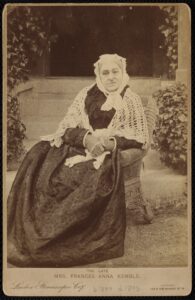
Her writing went on to perpetuate the memory of her time strutting upon the stage of life. In 1875, the Atlantic Monthly serialized fragments of her autobiographical recollections as “Old Woman’s Gossip.” She later published them as Records of a Girlhood (1878). Her Records of Later Life and Notes on Some of Shakespeare’s Plays appeared in 1881. Further Records, the final installment of her memoirs, came out in 1890. She moved in with Fan’s family in London in 1888. Her friend Henry James quite aptly described her death in 1893 in a letter to her other daughter, Sarah, as seeming “quite like the end of some reign or the fall of some empire.”
Article by Liesl Dees
Posted August 6, 2026