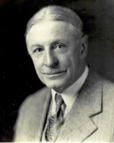
 As the Minister of All Souls Unitarian Church in Indianapolis, Indiana, from 1905 to 1938, Frank (Smith Calthrop) Wicks (February 15, 1868-December 21, 1952) was a leading Unitarian minister of the Progressive Era. During his long pastorate, he grew what was at first the sole Unitarian church in Indiana –a state that fell under the dominance of the Ku Klux Klan in the mid-1920s — from fewer than 50 members to over 500. Remembering the civic role played by parish churches in the New England communities where he had been raised, he referred to All Souls as “A Religious Center with a Civic Circumference,” and was widely engaged in civic affairs himself. He signed the Humanist Manifesto of 1933. When asked when he had become a humanist, he replied, “I didn’t notice any change in my point of view. But I discovered, when the humanist movement was defined, that I would fit into that picture.” His idea of God was revealed in nature, evolution, science, reason and the human heart.
During the early 1920s, when political corruption and the influence of the Ku Klux Klan reached a crescendo in both the city and the state, Wicks was a consistent, non-partisan voice for freedom of speech, political reform, and accountability. He defended, as did the new American Civil Liberties Union, the rights of both anarchists such as Emma Goldman and socialists such as Indiana’s own Eugene Debs to be heard by the public. He was also a leading voice for accepting evolution, for sexuality education, interfaith cooperation, and governmental reform.
Wicks did not speak out directly against the Klan. To do so would have endangered not only himself, but also his congregation and his family. Some estimate that in 1924 over forty percent of white, male, Protestant voters in Indianapolis were either dues-paying members of “The Invisible Empire” or at least sympathizers. He was close to those who did put up more public resistance. His friend, author Meredith Nicholson at a convention of 1800 Democrats held in Indianapolis, asked, “Isn’t it strange that with all our educational advantages, Indiana citizens could be induced to pay $10 for the privilege of hating their neighbors and wearing a sheet.”(1) Wicks did speak out against the election corruption that gave the Klan influence at both City Hall and in the State House. Yet in 1925, he also endorsed a pending piece of eugenics legislation. Such measures were then considered “scientific” and future-oriented, even among progressives.
Frank Wicks did not come to the ministry by any direct route. His father, James Francis Wicks (b. 1840, Trowbridge, Wiltshire, England) was, at the time of his son’s birth, superintendent of a woolen mill in Millville, Massachusetts, in the Blackstone River Valley, close to Rhode Island. His mother, Eunice M. Corey (1841-1925) seems to have been a rather starchy product of Puritan and orthodox New England congregationalism. Frank must have been a bit rebellious. They sent him away to Peekskill Military Academy, along the Hudson River, in New York. Declining a career in the military, Frank considered studying law, then worked as a teacher and a journalist before friend of his told him that his ideas sounded like those of a Unitarian.
Seeking out a deeper conversation with a Unitarian minister, he found as he later wrote, “I had already become a Unitarian, but like so many others, I did not know it.”(2) He soon enrolled at Meadville Theological School, the Unitarian seminary in Meadville, Pennsylvania, graduating in the Class of 1894. His father was by now President of the Wicks Manufacturing Co. in Worcester, MA. Frank was able to study three semesters more at Harvard Divinity School.
His second post, from 1897 to 1905, was as Minister of the First Parish in Brighton, MA, across the Charles River from Cambridge. That congregation also had a new church building on Chestnut Hill Avenue, toward the more fashionable, residential end of the village.(3) There, on June 20, 1899, Wicks, 31, was married to Elizabeth Goodnow, 24, the daughter of a family active in the congregation that had prospered in the hardware trade. Wicks was both groom and co-officiant in the wedding, along with a Unitarian colleague who signed the marriage license. “Society People Attended in Large Numbers,” said the Boston Globe.
While in Brighton, Wicks was also involved in the wider Unitarian cause. For nearly three years, he preached on Sunday afternoons to the Unitarians in Malden and served them as their pastor. He was also an officer of the Benevolent Fraternity of Unitarian Churches, which did outreach to immigrant communities; of the Unitarian Sunday School Society; and of the Unitarian Summer Meetings Association, leading its programs on Star Island, off the coast of New Hampshire.
The American Unitarian Association in 1905 was seeking an energetic and effective minister to serve the fledgling congregation in Indianapolis, formed just two years before. It was then the sole Unitarian group in a state where Universalists were the predominant religious liberals, and in a city where the Plymouth Church (Congregational) had long been rather open and liberal. AUA President Samuel Eliot asked that Wicks be considered. When he preached for them, both Frank and Elizabeth loved the warm openness of the people, free of New England stuffiness.
Nonetheless, the success Wicks had in growing the Indianapolis congregation probably rested in no small part on his distinctive New England accent, his leadership in the local Harvard Club, and his reputation of standing for high intellectual, social, and ethical standards. Elizabeth was known for her “Boston tea parties.” Yet, tellingly, the local (Protestant) Ministerial Association rejected Wicks for membership. The only clergy to welcome him were Dr. Hayes, the liberal pastor of First Presbyterian, who was censured by his own people for doing so; Father Gavisk, who said, “I may be excommunicated for it, but here I am,” and Rabbi Feuerlicht of the local Reform congregation. Gavisk later referred to the rabbi, Wicks, and himself as “the Trinity.”
The Indianapolis Unitarians were then holding their services in a very modest building on Alabama Street that had been built by Presbyterians as their temporary home while they raised a far more elaborate building nearby, in what was then a fashionable middleclass neighborhood. Local wags referred to it as “Wicks’s Cigar Box,” since the liberal preacher there was known for smoking (usually a pipe), taking a social drink, wearing red ties, and even endorsing dancing in the church! His idea of a “reasonable Sunday” included allowing movies, baseball, and other sports. This too was thought avant garde. Choosing to stay on the same site, Wicks and his flock soon raised their own new structure, marked by a homelike aura of approachability. It was both designed and built by the architectural firm of Vonnegut and Bohn, of which Kurt Vonnegut Sr. (father of the writer Kurt Vonnegut) was a partner. Kurt Sr. was also a member of the church.
All Souls Unitarian Church was dedicated on January 15, 1911. That building and Wicks’s ministry nurtured the religious humanism of the architect’s son, the writer Kurt Vonnegut, Jr. The dedication ceremony was also attended by the daughter of another local architect, Katherine Gibson, then only 17.
When Frank Wicks arrived, Universalists were far better established in the state than Unitarians. There was a Universalist church around the corner. Its Interim Minister, the Rev. Mrs. Snyder, was dismayed when her successor proved to be quite conservative and biblical in his orientation. Wicks had given a Sunday evening sermon in 1907 on a key theme of classical Universalism, “Good Men in Hell.” In 1914, the American Unitarian Association first published a version of “Good Men in Hell” as a pamphlet. It was so popular that it eventually had some 35 printings. Mrs. Snyder joined All Souls, proud of becoming “the mother of four presidents of the Young People’s Society of All Souls Unitarian Church.” Other new members, such as the Vonneguts, descended from German freethinkers who had come to the Midwest after the failed European revolutions of 1848.
Wicks became one of the best-known liberal voices in the Midwest, widely sought after as a lecturer and guest preacher. More than a few of his 1200 sermons were printed and distributed. Later, as a regional vice president of the American Unitarian Association, he led its fundraising efforts in the area. He took a firmly modernist, rather than fundamentalist, view of the scriptures. When a local Methodist declared that it was “shameful” that someone of such opinions should represent the clergy of Indianapolis in the coordination of social services, Wicks invited his orthodox colleague to share his reasoning from the pulpit of All Souls. The press reported this, along with the Methodist’s declining. He also politely challenged some local Episcopalians, saying their declaration that true faith depended on the doctrine of the Trinity was “debatable.”
Each November, Wicks and Rabbi Feuerlicht alternated hosting a Union Thanksgiving service, which often included Universalists as well. He was a member of the Indianapolis Literary Club, on the board of the Art Association and of the Little Theater Society, a member of the Nature Study Club, and an active Mason. He was a member and became president of the Contemporary Club, a prestigious group that addressed civic matters. He led the Playgrounds Association when it established the city’s first public swimming pools. He arbitrated labor disputes and headed the Progressive Education Association. In 1931-32, he headed the Smoke Abatement League, aimed at reducing air pollution. Once a year he turned a Sunday service over to the Humane Society, concerned with the prevention of cruelty to both animals and children. He served on the board of the Family Welfare Society and supported the Florence Crittenden Home for unwed mothers, the YWCA, and Boys Club – where he was known by the boys as the most approachable minister they had ever met. Wicks was affluent enough to often spend summers in England and Europe, doing so sixteen times between 1921 and 1939.
Frank and Elizabeth Goodnow Wicks wanted a family, but were never blessed with children. Instead, they took into their home at 111 East 44th Street four children from a local institution, the Children’s Guardian Home. Each came at roughly three years of age and was given the Wicks surname and a new given name: a daughter they named Coryenne, born in 1911; a son they named Warwick, born in 1913; another boy, Devon, also born in 1913; and a girl, Lynton, born in 1914. The first two had been formally adopted shortly after their arrival in the Wicks home, but Devon and Lyndon remained foster children. Elizabeth struggled not only with a lingering illness, but also with motherhood. Devon and Lynton were students at a local private and progressive institution, the Orchard School. By 1926, Elizabeth felt that she could no longer cope with mothering. The older children, as adolescents, were sent to eastern boarding schools. Lynton went back to the Guardian Home. Devon refused adoption unless Lynton was also adopted, and Lynton rejected adoption offers by other families. Three years later, Elizabeth, then 53, died. She was eulogized for a lineage going back to the American Revolution, and for leading the local Progressive Club. The “home women” of All Souls (those not employed outside the home) were known as “The Elizabethans.” They helped raise funds to add a wing to All Souls, with a chapel dedicated to Elizabeth Wicks.
Remarkably, Lynton Wicks, as a married adult, was later adopted by Wicks and his second wife, Katherine Gibson. Lynton, having left the Guardian Home at 18, found work in a box factory – until the Great Depression caused layoffs. Then, in some desperation, she sought out Wicks, whom she had always found sympathetic. Katherine also liked and helped the young woman, who soon married and had two children. Frank Wicks married Katherine in London during the summer of 1932. They kept the marriage secret for several years. Only when Frank fell critically ill, in 1935, was his second marriage made known. His illness was closely followed in the local press. In 1948, Katherine proposed that they adopt Lynton. Wicks agreed, and even asked Lynton’s husband, Sheldon James Peirce, if he would like to be adopted as well. He demurred. Katherine was well on the way to becoming a notable author, particularly of children’s books. Some of her best-known titles were the Tall Book of Bible Stories, Oak Tree House, Cinders, Pictures to Grow up With, and the Tenggren Tell-it-again Book.
Frank Wicks had advanced views on marriage and the family. In 1934, he began teaching a course on the topic at Butler University. As a Disciples of Christ institution, that college no doubt intended to stem the rising incidence of divorce brought on by the Great Depression. Wicks favored a more egalitarian approach to the relations between women and men. Wicks spoke of a successful marriage as being “a union of body, mind, heart and soul in which each holds the other to his or her highest and best. A union which the church may bless and the state may sanction, but which neither can create or annul.” He said that “the body must have its rights, but the tie must be more than physical,” and urged that sex education begin at an early age. When asked if a pledge to “love and cherish forever” should be demanded, he simply replied, “One cannot promise the continuance of any emotion. But he or she can pledge loyalty, for that is within the province of the will.”
Wicks defined worship as “a lifting of the heart that it may be touched by love; a lifting of the mind that it be informed by truth – then worship is the noblest and highest attitude of the soul.” After 1924-25, the chancel at All Souls was flanked by busts of Thomas Paine, whose devotion to freedom of thought reflected his own, and of Ralph Waldo Emerson, Unitarian minister/sage. Thereafter, all sermons by Wicks were summarized in the Indianapolis Star, while reporters at the Times, which won the Pulitzer for reporting on the KKK, also reported his lectures for a time. At the back of the nave, a hearth room or parlor featured not only a fireplace for warm debates, but also a set of stained-glass windows designed by Brandt T. Steele, depicting the Tree of Life, known as Ydrigsall in Nordic mythology. It was a contrast to the Tree of Knowledge of Good and Evil, from which Adam and Eve were said to have eaten. Wicks felt that the first step toward true salvation, in the sense of health and wholeness, was to realize that one did not need to be “saved” in the orthodox sense.
In 1938, at the age of 70, Frank Wicks retired and became the Minister Emeritus of All Souls. His hand-picked successor, the Rev. E. Burdette Backus, benefited from his loyalty and devotion to the church. Ten years later, on his 80th birthday, Wicks opened a letter that he had written to himself as a young man. It read, in part, “When I meet you at four score years, I hope to find you a lovable old man . . .[not] a sour, crabbed, grumbling old kill-joy, frowning on the pleasures of youth, intolerant of their views, impatient with their follies and mistakes, lamenting your aches and ills, talking about the good old time and the degeneracy of these days.”
Frank Wicks had lived up to those aspirations. In retirement, he was a frequent guest preacher at other Unitarian churches, but was always found in the second pew from the front at All Souls when he was home. He helped his successor by calling on every new member of his home congregation. When he died in 1952 at the age of 84, they said of him, “He is no longer with us. His good works have given him immortality in the minds of the living.”
References:
(1) Indianapolis Times, November 1, 1926, page 2.
(2) “Are You a Unitarian Without Knowing It?” became the theme of an advertising campaign later conducted by the Unitarian Laymen’s League.
(3) The Brighton Unitarian church building still stands. The congregation did not survive the Depression and WW II. The stone building is now home to a Buddhist organization.
Article by John A. Buehrens, May 2026