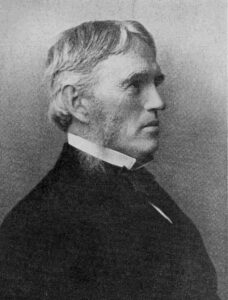
 Horatio Stebbins (August 8, 1821 – April 8, 1902) served as minister of the First Unitarian Church of San Francisco for thirty-five years, 1864 to 1899. Having struggled economically to gain a higher education, he finished Harvard College and Harvard Divinity School in his late twenties, and served Unitarian parishes in Fitchburg, Massachusetts, and Portland, Maine, before being selected as the successor to Thomas Starr King. He soon played a leading role in establishing the University of California at Berkeley. He served as a regent for twenty-six years. Through his parishioner, writer Brett Harte, Stebbins was sought out by young Samuel L. Clemens, known as Mark Twain. Late in his life, Twain admitted that he had been broke, drinking and almost suicidal when he met with Stebbins, who wrote a letter that helped Twain re-establish himself in New York as a successful writer.
His son Roderick Stebbins (1859-1928), who followed him into the Unitarian ministry, called him “preeminently a helper of men, materially, intellectually, morally, spiritually.” He was admired not only for his preaching and ex tempore prayers, but also for his personal character, marked by generosity of spirit and indefatigable faith. In 1898, San Francisco artist Bruce Porter, who grew up under his ministry, celebrated his influence in verse:
Honored by humble men, he walks these streets,
Priest of the wider parish of the heart:
A tower of strength to the impetuous State,
Where steadfast and serene he fills his part;
Still offering wisdom, though the hour grows late;
Still lending courage in the face of Fate.
Unterrified and kind, large as the light of day,
He passes on.
We lift our eyes, sodden with petty ills,
And, lo! visions of forests, of the silent hills,
And the deep tides of the obedient sea!
Stebbins was born and raised as a farm boy in the rural hill country of western Massachusetts. An older cousin, Rufus Phineas Stebbins (1810-1885), from the same town of South Wilbraham (now Hampden) preceded him in the Unitarian ministry and became the first president of Meadville Theological School. Horatio’s parents, Calvin and Amelia Adams Stebbins, were said to possess more books than anyone in the town except the minister. The local church was Congregationalist, but both cousins became Unitarians. Horatio’s mother, known for her terse wisdom, died when he was still a boy. He became determined to obtain a ministerial education. In his teens he boarded with a family in nearby Springfield, Massachusetts, doing chores for them in order to attend high school there. After a year, he set out on foot for Ithaca, New York, to attend an academy run by a family friend. He paid $1.25 a week for room and board, earned again by working so diligently that his health was endangered. He then taught younger children until he was given a scholarship to prep for college at Phillips Exeter Academy, where he was the orator for the Class of 1846. Much later, in 1883, was orator at the centennial of that school. Admitted to Harvard College as a junior, he became class chaplain. At Harvard Divinity School he again had to work to stay enrolled. Allowed by the faculty to raise potatoes on a nearby plot, he spent a dry summer carrying water from the well behind Divinity Hall. The crop earned him a hundred dollars. He was nearly 30 years old when called to serve the First Parish in Fitchburg, married Mary Ann Fisher of nearby Northborough, and was ordained on November 5, 1851.
In January 1855 Stebbins accepted a call as colleague successor to Rev. Ichabod Nichols of the First Parish in Portland, Maine. Like his cousin, he was quite forthright about his temperance, anti-slavery, and reformist social views, Horatio was admired for his pulpit presence, combining independence of thought with dignified piety and a reverence for scriptural wisdom. In 1861, when the attack on Fort Sumter began the Civil War, he draped his pulpit in the national flag.
His patriotism and broad-church Unitarianism aligned him with Rev. Henry Whitney Bellows of New York, the leader among Unitarian ministers and President of the U.S. Sanitary Commission, predecessor to the Red Cross. When Thomas Starr King died in San Francisco on March 4, 1864, Bellows went at once to California to help that church. He asked Stebbins to seek a leave from his Portland parish in order to fill his own pulpit at All Souls in Manhattan, and to be prepared to be called to California. Stebbins did as he was asked. Bellows considered the better-known Edward Everett Hale, author of the patriotic tale, “The Man Without a Country,” but considered Stebbins a better preacher and pastor. Stebbins, his wife and their two children, Mary Louisa (“Minnie”), 10, and Roderick, 5, arrived in San Francisco on September 7, 1864.
On Thanksgiving Day of that year, Stebbins gave a sermon that was so apt in its analysis of the course of the Civil War and the character of President Lincoln that leaders of the congregation insisted that it be printed. When Lincoln was killed on Good Friday, April 14, 1865, the next day Stebbins spoke before more than ten thousand San Franciscans who had gathered to mourn him.
On Sunday October 8, 1865, around noon, a significant earthquake jolted all of San Francisco. The City Hall, a firehouse, and other public buildings suffered damage. Congregants at the Unitarian church on Geary at Stockton were singing the closing hymn when trembling began. They then all fell silent, looked up at the roof above them, and then stared as the central pipe of the organ on the chancel toppled over the heads of the choir and landed in front of the first pews. Having just sung the stanza, “The seas shall waste and skies to smoke decay,/ Rocks turn to dust, and mountains fall away,” they all exited, many with hymnals in hand. Stebbins calmed them, leading them back inside to finish the hymn: But fixed this Word, this saving pow’r, remains; Thy realms shall last, thine own Messiah reigns,” and to receive his benediction. He repeated the whole hymn at the evening service.(1)
One public role that Stebbins inherited from Starr King was to serve on the board of the College of California, a men’s liberal arts institution started by Congregationalist minister Henry Durant. Located in Oakland, lest the students fall into the corruptions of San Francisco’s Barbary Coast, it had outgrown its original building, and had been given substantial acreage north of Oakland. There, in 1866, the trustees inspected the land and, while sitting on high rock, watched two ships sail out through the Golden Gate. Starr King’s friend and fellow, Frederick W. Billings, recalled Bishop George Berkeley’s memorable phrase, “Westward the course of empire takes its way.” He suggested naming the area the Anglo-Irish idealist philosopher. Stebbins chaired the trustees. When his parishioner, Governor Frederick Low, proposed combining the College of California with funds for school to teach the mechanical and agricultural arts, Stebbins readily accepted, since the College had land, but no money, while the proposed university had money, but no land. He then led the trustees in surrendering the college land and charter to the state, on the condition that the new university always include a liberal arts college.
“As I have studied the formative agencies of the University of California,” wrote one early historian of the institution, “I have come to believe that above all others the mind that gave largeness and character to the university movement was that of Dr. Stebbins.”(2) He was a favorite speaker at early baccalaureate services and served as a Regent of the University until 1894, encouraging the admission of women and of students with limited means.
Earlier in 1866, Stebbins went by steamer to Portland, Oregon, invited by a few Unitarians there. He spent three weeks among them, as they raised funds to purchase a building lot, to incorporate as a religious society, then seek a minister to serve them. He wrote to William Greenleaf Eliot, Minister of the Unitarian church in St. Louis, who then recruited his son, Thomas Lamb Eliot. The following year, young Eliot and his wife came through San Francisco on their way to serve the second Unitarian congregation on the Pacific Coast, witnessing an experiment in liberal evangelism, modeled on what some conservative evangelicals were doing: preaching in a theater. Perhaps more of the unchurched would come there than to services in an imposing cathedral, where existing members rented all the best pews, and visitors had to be ushered up to the gallery. The theater effort was impressive, but it resulted in few new Unitarians.(3)
One visitor to the church that fall was journalist Samuel Clemens, later called Mark Twain, encouraged by his friend and fellow writer, Bret Harte. Twain was broke, drinking heavily, moving from one cheap boardinghouse to another, unable to pay. He later referred to this as his “slinking period.” Still later, he admitted he was close to taking his own life. “I put the pistol to my head but wasn’t man enough to pull the trigger,” he wrote. Unmarried, unhinged, and about to turn thirty, he wrote to his brother and sister-in-law in October:
I never had but two powerful ambitions in my life. One was to be a pilot, & the other a preacher of the gospel. I accomplished the one & failed in the other, because I could not supply myself with the necessary stock in trade – i.e. religion. I have given it up forever. . . But I have had a “call” to literature, of a low order, i.e., humorous . . .to excite the laughter of God’s creatures.(4)
Six weeks later, he wrote his mother: “I am thick as thieves with the Rev. Dr. Stebbins. I am running on preachers now altogether; I find them gay. Stebbins is a regular brick. Whenever anybody offers me a letter to a preacher, I snaffle him on the spot.” Planning to go to New York, he had “snaffled” (conned) Stebbins into giving him a letter of introduction to Bellows:
I shall make Dr. Bellows trot out the fast nags of the cloth for me when I get to New York. Bellows is an able, upright, and eloquent man, a man of imperial intellect and matchless power. He is a Christian in the truest sense of the term.(5)
Stebbins and Bellow gave Twain a second chance. Back East, he succeeded as a writer and humorist, but he was cruel to his one-time Unitarian friend, Bret Harte, and he never did acknowledge, except obliquely, how meeting with Stebbins may have saved him from suicide.
The minister himself often felt lonely. He was the only Unitarian minister on the Pacific Coast, save for Charles Gordon Ames, a Unitarian evangelist starting new congregations, and young Eliot in far-off Portland. He therefore welcomed visits by colleagues from the East, and none more so than that of Ralph Waldo Emerson in April 1871. Stebbins persuaded him to preach at a Sunday evening service. He read his essay, “Immortality.” Many hearers later recalled only that he knocked over the flowers on the pulpit. Yet young church leaders Charles Murdock, then 30, and Horace Davis, 31, arranged for Emerson to give several more lectures. They did not go much better, although the Sage of Concord soared to rather lofty heights. Stebbins wrote, “I thought the people would tire in the sockets of their wings, if they tried to follow him.”(6)
Later pulpit guests included Edward Everett Hale, who had become Chaplain to the U.S. Senate, and women’s rights advocate Julia Ward Howe, who noted the role Lucy Ward Stebbins had in her husband’s ministry. He also welcomed the Hindu reformer, Protap Chunder Mozoomdar, author of The Oriental Christ. “It was a memorable evening,” Murdock later recalled, “when, in Dr. Stebbins’s parlor, he seated himself on the floor in his native fashion and we, a stiff-kneed and perverse generation, attempted to unbend and follow him.”
Stebbins own oratorical style was unpretentious, simple and direct. In 1869, Bowdoin College in Maine invited him to speak and honored him with the degree, Doctor of Divinity. On July 4, 1876, he was chosen to give the principle oration at San Francisco’s celebration of the nation’s centennial. That address was so well-received that it was printed as a broadside.
By then, however, the U.S. was in a severe economic recession, started by the Panic of 1873. The congregation had responded by forming a Society for Christian Work to alleviate the distress of the poor, including the local Chinese, who had become scape-goats for the Workingmen’s Party of California, which expressed racist resentment in repeated acts of violence and thuggery. Stebbins spoke out against anti-Asian prejudice, confronting both Democratic and Republican state leaders in a speech welcoming an important delegation from Japan. His close friend and parishioner, now U.S. Representative Horace Davis, lost re-election for a third term, seen as being insufficiently anti-immigrant. Davis was the son of a one-time governor of Massachusetts, and was married to Starr King’s daughter, Edith. He taught the adult Bible class at the church for nearly sixty years. So devoted was he to that work that he resigned as President of the University of California after only two years rather than agree to live in Berkeley and have to give it up. Davis and Stebbins also helped promote a Unitarian mission to Japan and to Japanese Americans in the Bay Area. Another parishioner, James Otis, served as Mayor of San Francisco, but succumbed to the pressures of the position and died in office.
Stebbins was not only a compassionate pastor, he also suffered from his own family tragedies. His wife Mary Ann was increasingly ill with tuberculosis, and finally died on February 4, 1875. Their daughter, Minnie reacted by eloping at 17 with an ill-paid bank clerk who was the father of the child she was expecting, born on Christmas Day of that year. The next year, on a trip East, Stebbins, then 55, met Lucy Elizabeth Ward, 32, a Chicago Unitarian, and soon made her the second Mrs. Stebbins. Both Roderick and Minnie approved. In 1880, however, Minnie came to her father and tearfully confessed that she was having an affair with a married man, her dentist. Stebbins took his son-in-law, Edward Schroeder, with him to confront the man. Assuming that the dentist had seduced Minnie, Stebbins slapped the man and muttered that if he had had a gun, he’d have shot him. A few weeks later, Schroeder returned and did just that, before witnesses. His murder trial became a cause celebre, especially when the all-male juror acquitted the killer on the grounds that it was a crime of honor.
By the 1880s, the huge church raised for the throngs Starr King had attracted had a growing number of empty pews. Trustee Andrew Smith Hallidie, inventor of the cable car, was asked to survey deferred maintenance, and discovered that the whole building was structurally unsound. The earthquakes had done more damage than previously realized. The neighborhood around Union Square had also changed, becoming both commercial and adjacent to a red-light district. Residential areas were moving further west in the city. The difficult decision was made to sell the building as a tear-down, and to build a more sustainable structure at Franklin and Geary. Dedicated in 1889, it still stands.
By the 1890s, Stebbins was in his 70s. He continued to preach morning and evening services each Sunday. Another economic crisis hit in 1893. There was no provision for his retirement. New Unitarian churches had emerged in nearby Oakland, Berkeley, and other West Coast cities. There were now twenty some younger Unitarian ministers in the Pacific Unitarian Conference. Stebbins deferred to them in the Pacific Unitarian, edited and published by Charles Murdock. Although his parishioners occasionally insisted on a sermon being printed, Stebbins himself was far too modest to publish anything himself. Lest his piety be lost, his son Roderick quietly paid a stenographer for a year to take down his father’s eloquent but ex tempore prayers each Sunday, then edited them and had them published. In 1898, in such ill health that he was no longer able to preach much of the time, Stebbins was named Minister Emeritus. He stayed on in San Francisco until his successor, Bradford Leavitt, was settled in 1900.
He then moved to Cambridge, Massachusetts. His children from his second marriage were both nearby. Daughter Lucy Ward Stebbins was studying at Radcliffe, and son Horatio at M.I.T. Roderick was serving the Unitarian congregation in nearby Milton. Lucy went on to a transformative career as the Dean of Women at the University of California; Horatio, Jr., as a professor of engineering at Stanford. Their minister father died in Cambridge in 1902. A front page obituary in the leading San Francisco newspaper carried a large portrait of him, mutton chops and all, and as “broad and liberal in his views and modest but courageous in their expression . . . ever to be found battling for the best … generally recognized as one of the strongest personal factors in elevating the standards of life and citizenship in the community that boasted his membership.”(7)
References:
(1) Charles A. Murdock, A Backward Glance at Eighty (San Francisco: Paul Elder & Co., 1921), 127-128; and Murdock, Horatio Stebbins, 53-54. Complete lyrics of the Alexander Pope hymn, found at https://hymnary.org/text/rise_crowned_with_light_imperial_salem_r
(2) William Carey Jones, “The Making of the University,” quoted in Murdock, Stebbins, 72.
(3) Murdock, Stebbins, 55-56.
(4) Samuel L. Clemens to Orion and Mary E Clemens, October 19-20, 1865, Mark Twain’s Letters (Berkeley: University of California Press, 1988-2000), Vol. I, 322-323.
(5) Murdock, Stebbins, 54-56.
(6) Murdock, Stebbins, 66.
(7) San Francisco Call, Volume 87, Number 131, 10 April 1902, page 1.
Article by John Buehrens
Posted June 4, 2026