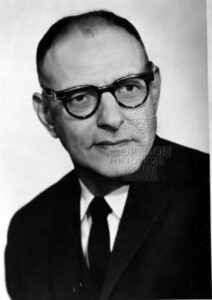
 Richard Morrow Steiner (1901-1975) was senior minister of the First Unitarian Church in Portland from 1934 to 1965. An inspirational preacher, he helped rebuild the congregation after a decline during the Great Depression. As an advocate of the social gospel, he was personally involved in the community and inspired others to a life of social action.
Richard Steiner was born July 1, 1901, in Sandusky, Ohio, where his father was a parish minister. His parents were Dr. Edward Steiner, an ordained Congregational minister, and Sara Levy. In 1903, the family moved to Grinnell, Iowa, when Dr. Edward Steiner was appointed as Professor of Applied Christianity at Grinnell College. Richard Steiner graduated from Grinnell College in 1923 with a B.A. in English. He earned an M.A. in rhetoric from the University of Michigan in 1927. He worked as a reporter for the Cleveland Daily News and the Chicago City News Bureau and taught English at Bradley College and Washington State College. He earned a B.D. from the Chicago Theological Seminary in 1933, after which he taught religion at Grinnell for a year.
First Unitarian in Portland had been served for thirty years by Rev. William Greenleaf Eliot II (1866-1950). When he retired in 1934 the trustees began the search for a worthy successor. Upon inquiries from Dr. Eliot, two professors at Chicago Theological Seminary recommended Richard Steiner as their outstanding student of homiletics. The board asked a prominent church member, Charles A. Hart, to interview the Steiners in Grinnell. Steiner then visited Portland and the congregation voted unanimously to call him as minister. He took up his new position on September 15, 1934, at age 33. Steiner was ordained as a Congregationalist, but identified also as a Unitarian, and also as a Hicksite Quaker, having developed pacifist convictions, and eventually also as a Universalist. As a liberal Christian, he was strongly committed to a social gospel ministry in which the church was deeply involved in the community. In the three decades following 1940 the previously apolitical Women’s Alliance focused its efforts on racism, sponsoring numerous programs, classes and activities. An interracial Friendship Club was formed in 1944 and in the 1950s, their activities expanded to include problems of migrant workers. Many individual members of the congregation were active in social justice activities. Some prominent examples include: Allan Hart who was a founding member of the Oregon Affiliate of the American Civil Liberties Union and handled the case that overthrew the Oregon Alien Land Law; Charles Davis who was the long-time chair of the Oregon ACLU; Don Marmaduke who as a young lawyer went to Mississippi to provide legal assistance for integration. Many First Unitarian congregants were members of administrative or advisory boards of non-profit organizations.
Steiner’s gifts as a dynamic preacher and energetic leader were an important stimulus to a church suffering the effects of the Great Depression. Membership, contributions and church school attendance were down. Steiner immediately tried to revitalize the church. He engaged as a consultant, social scientist Dr. H. Paul Douglass, who had worked with the recent Unitarian Committee on Appraisal. The Portland church adopted many of Douglass’s recommendations but they did not immediately bear fruit. Church membership continued to decline from 1934 to 1942. The church began a growth spurt when the U.S. entered World War II which increased greatly in the postwar period. To help with the growth of the church school resulting from the baby boom, First Unitarian hired its first professional Director of Religious Education, Gertrude McIntosh, upon the urging of the minister and church lay leader, E. B. MacNaughton, then serving as Moderator of the American Unitarian Association.
The church continued to prosper for the remainder of Steiner’s ministry. He was awarded two honorary Doctor of Divinity degrees, one by Grinnell College in 1943 and a second by the Starr King School for the Ministry in 1965.The growth was such that on Easter 1953, the church had to begin holding two identical services. In 1955, ground was broken for the Chapel House to provide additional space for the church school. In the 1950s First Unitarian “spun off” three new congregations: Michael Servetus Fellowship in Vancouver, WA (now the Unitarian Universalist Church of Vancouver), West Hills Unitarian Fellowship, and Eastrose Fellowship. All three new congregations still exist.
Steiner was personally active in the Portland community. Soon after coming to Portland, he made a strong public statement opposing the “Red Squads” of the Portland Police. During World War II, he served on the Selective Service appeals board and as a leader in the local USO. He was a long-time member of the City Club, serving as president in 1951. In 1963, he was a member of the Committee to Study Segregation in the Public Schools. He was an active member of the ACLU and won its E. B. MacNaughton Award in 1964. He was a director of the Portland Civic Theater in 1939-40 and occasionally acted in plays.
Steiner was also active nationally in the American Unitarian Association (now the Unitarian Universalist Association). In 1937 he became a member of the Ministry Committee of the AUA. Throughout his career he was a sought-after guest minister by Unitarian churches all over the United States.
Starting in 1956, Steiner began to reduce his outside activities in order to concentrate on the pastoral care of his growing congregation, Along with providing counsel to his parishioners, he published A Guide to a Good Marriage (Beacon Press, 1955). In 1962 he asked the church to begin planning for his retirement. A pulpit committee was eventually formed. After its evening meeting on July 29, 1965, a homeless person who had gotten into the church started a fire which spread and destroyed the sanctuary (now the Eliot Chapel) and essentially gutted the church. After considerable debate, the congregation voted to rebuild on the same site. For ten months the congregation met in temporary quarters at the nearby Seventh Day Adventist Church and used rooms in the Red Cross building. Wednesday night services were held at the West Hills Fellowship.
Richard Steiner had married Deborah Lantz on August 17, 1927, in Port Chester, NY. They raised two sons, Henry York and David. After his retirement in 1965, Richard and Deborah Steiner moved to a retirement community, Pilgrim’s Place, in Claremont, CA. While at Claremont, Steiner and several others formed a death with dignity committee in response to the prolonged death of a member of the community. After a long illness and a fall, Richard Steiner ended his own life on August 4, 1975. His personal example was one of the influences that led to the Oregon Death with Dignity law.
Sources
Earl Morse Wilbur and Evadne Highlands, A Time to Build: The First Unitarian Church of Portland, Oregon, 1866-1966, First Unitarian Society, 1966.
Cindy Cumfer, Toward the Beloved Community: The First Unitarian Church of Portland, Oregon, 1865-2015, First Unitarian Church, 2015
“Rev. Steiner, 74, dies in California” The Oregonian, August 5, 1975, p. 30.
Edward Steiner obituaries, http://www.grinnell.lib.ia.us/Obit/S2/SteinerEdwardA.pdf
David Steiner, “My Family,” http://www.davidesteiner.com/my-family-access.html
Richard M. Steiner, A Guide to a Good Marriage, Beacon Press, 1955.
Article by Jeffrey Kovac, Ph.D.
Published June 4, 2026.