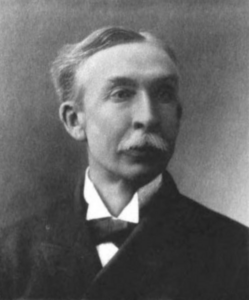
For forty years, Charles Fletcher Dole (May 17, 1845- November 27, 1927) served what is now First Church (Unitarian) in Jamaica Plain, Massachusetts. A prolific author, Dole was both childhood pastor and mentor to Emily Balch Greene (1867-1961), founder of the Women’s International League for Peace and Freedom and winner of the Nobel Prize for Peace in 1946. Although the Dole surname is often associated with pineapples, Hawai’i, and American imperialism, that is hardly the fault of Charles, who was both a staunch anti-imperialist and chairman of the Association to Abolish War.
Born in Brewer, Maine (across the Penobscot River from Bangor), he was the son of Rev. Nathan Dole (1811-1855, and his wife, Caroline Fletcher Dole, 1817-1914), both evangelical Calvinists. An older uncle, Rev. Daniel Dole, went in 1840 as an early missionary to Hawai’i, under the American Board of Commissioners for Foreign Missions. In 1850, Nathan, suffering from tuberculosis left the pastorate to edit publications for the ABCFM. He then died in 1854. His widow took ten-year old Charles and his younger brother, also named Nathan, to Norridgewock, Maine, where she had grown up.
About his boyhood Charles later wrote, “My religion had not yet given me the slightest desire to go to heaven along with the other good little boys, the story of whose piety and early death had already clouded the way of the good life with mystic dread.” Eventually his guilt about his spiritual state drove him “…to a considerable period of gloom and wretchedness,” about which his mother, “…being a literalist in handling the Bible…,” was unable to help him other than to send him “…to the graveyard for an outing on a Sunday afternoon.” The teen later emerged from his spiritual crisis with the resolve “to live right, even if he were destined to ‘perdition.’”
Despite eye problems and a brief stint in the home militia during the Civil War, Charles Dole won both admission to Harvard and ample scholarships, graduating summa cum laude in 1868, when he gave an oration on “The Darwinian Theory.” In it, he explained both why the public was shocked by Darwin and how religion and science could be reconciled by interpreting the Bible in historical perspective. Yet to stay true to his parents’ faith, he then studied for the orthodox Congregationalist ministry at Andover, where he chafed at the orthodox theology of Edwards Park (who had taught his father). There he delivered another graduation oration, “Church History and Congregationalism,” arguing for theological pluralism in congregations that should focus chiefly on community service and ethics, not doctrine.
After a semester at the University of Vermont, teaching Greek, he had earned enough money to marry Frances Drummond, from another family of Maine congregational clergy. Despite its evangelical orientation and fragile finances, he then accepted a call to serve as minister of the Plymouth Congregational Church in Portland. When he and Frances vacationed in Bar Harbor, he heard Unitarian James Freeman Clarke and preached at the Union Church himself. Back in Portland he joined the “Fraternity Club,” made up of Unitarians, Universalists, Swedenborgians, and local professional and business leaders. For that group he delivered a paper on the subject, “Can Christianity hold its ground as the religion of thinking men?”
In 1876, his reputation as a liberal Congregationalist led to an offer to come to Jamaica Plain, where Clarke lived, as associate and successor to the aging Rev. James W. Thompson. Although a Unitarian in his own theology, Thompson had resisted adding that sectarian term to the name of the First Congregational Society. Dole joined him in wanting a truly “community church,” crossing lines of class and doctrine. Installed as junior minister, he soon challenged the same wealthy trustees who had called him, hoping to abolish pew-ownership. He lost that argument, yet in 1881 became senior pastor.
His opposition to sectarianism resulted in Dole’s affiliation with the Free Religious Association. In his Catechism of Liberal Faith, published by the Unitarian Sunday School Society in 1895, he encouraged faith in an underlying “divine and beneficent” evolutionary process guiding the moral and spiritual development of humankind toward a “broad church” and a universal religion, while also asking. “What is the highest type of this development that we know?” Answer: “It is in the lives of men and women of the type of Jesus.” His books, The Coming People (1897) and The Theology of Civilization (1899) got mostly positive reviews, although Henry James objected to his overly optimistic anthropology, saying, “The coming people, for Mr. Dole, as I make out, are people who will, in every circumstance, behave with the highest propriety, and will be aided thereto . . . by an absence, within them, of anything that will prevent.”
In 1900, Dole published both Noble Womanhood and The Religion of a Gentleman. Although a proponent of women’s education and women’s suffrage, he retained enough gender essentialism to echo AUA President Samuel Atkins Eliot II (the son of Harvard’s Charles Eliot) in seeking to extend the impact of liberal religion by attracting more young college men of future influence. Although his book had a chapter on “The Soldierly Life,” extolling self-discipline, he called for moral not martial courage, as did William James later in “The Moral Equivalent of War” (1910).
Dole’s faith in spiritual progress was most evident in his last major work before World War I: The Coming Religion (1910). Even after the horrors of the Great War, he reiterated confidence in A Religion for the New Age (1920). There he echoed thoughts relevant to us a century later: “First, this a barbarous, or, if you prefer, a half-civilized world. Secondly, it is. . . an improving and improvable world. Thirdly, it every one’s business to . . . make [progress] prevail.” How? Through a spirituality “beneath and behind all religions,” based on kindliness, conscience, justice, gentleness, and good will. In 1906, Dole gave the prestigious Ingersoll Lecture on Immortality at Harvard. He left his listeners wondering whether he argued for an immortality of consciousness, or one of mere influence. That year Bowdoin College gave him an honorary D.D.
In many respects, Dole is best understood as an exemplar of the “Social Gospel” movement among religious liberals of the Progressive Era. One of Dole’s earliest publications, again for the Unitarian Sunday School Society, promoted civic engagement to resolve most social problems. The Citizen and the Neighbor (1885) spoke from a position of class privilege. Although quite radical in his theology, in his approach to social and political reform, Dole was a moderate, placing his faith in education and persuasion. His 1891 book, The American Citizen, expressed concern for the education and assimilation of immigrants, as did his affiliation with the American Patriotic League. In books like The Coming People (1897) and The Theology of Civilization (1899) he expressed the conviction that civilizing forces were gradually displacing violence and barbarism. He opposed “the pernicious doctrine, which survives from the ages of militarism, that fighting, whether in public or private, is needful to produce courageous men or to revive the virile spirit of a people.” In an era of “muscular Christianity” and Teddy Roosevelt’s machismo, Dole was a pacifist.
When his cousin Sanford Dole led in overthrowing the Hawai’ian monarchy and promoting the annexation of the islands by the U.S., he was both critical and embarrassed, yet quiet publicly. His anti-imperialism and pacificism only grew, however. After the sinking of the USS Maine in 1898 led to calls for war with Spain, Dole joined Unitarian Congressman Samuel Barrows in meeting with both House Speaker Thomas Reed and President McKinley to oppose such a step. At the war’s end, he adamantly opposed the imposition of U.S. rule on the Philippines, joining the Anti-Imperialist League. Yet when his son, James Drummond Dole, having graduated from Harvard, was offered the opportunity to go to Hawai’i to seek his fortune, he did not object. There James founded the Hawai’ian Pineapple Company, later Dole Foods.
On matters of race and poverty, Dole was also a reformer in the moderate mode. His two books The Spirit of Democracy (1906), and The Burden of Poverty (1912) reflect opinions common among the reformers in Boston’s Twentieth Century Club, which Dole served as President from 1902 to 1916. He hosted Booker T. Washington overnight when he spoke at the Jamaica Plain church. He served on the board of the Tuskegee Institute for nearly two decades. He and his wife also supported the Southern Industrial Institute, founded in 1898 by Universalist Rev. Lyman Ward in Camp Hill, Alabama. It served impoverished white youth, as did another Dole cause, Berea College.
Although he was no supporter of absolute “non-resistance,” feeling that armed defense of self, family and the innocent might at times be necessary, in 1915 he published a pamphlet called “Pacifist Principles.” He was shocked that even the Massachusetts Peace Society was open to calls for the U.S. to prepare to enter the war in Europe. That fall he and Balch and others founded the Association to Abolish War. Having retired in 1916, he did not attend the 1917 meeting of the Unitarian General Conference in Montreal, where Moderator William Howard Taft led the endorsement of the war. He sympathized with John Haynes Holmes, who soon left the AUA. Dole and his wife had moved to Hawai’i, where he spoke out vigorously against the war, adding that American troops had behaved barbarously in the Philippines. On returning home, he faced rebukes from Unitarian ministers, the Twentieth Century Club, even his church’s Men’s Club. He was disinvited from filling the pulpit at the Universalist church in Gloucester for defending conscientious objectors. In his final years, he kept up his advocacy for a world without war, criticized the Versailles Treaty for demanding punitive reparations from Germany, and defended Americans persecuted for unpopular views. In 1926, he wrote the introduction to a volume called The War Myth in United States History. He died the following year, eulogized by Unitarian theist Jabez Sutherland as a courageous “humanist,” “an American Gandhi,” and as the best religious thinker among his colleagues.
Sources
Paul T. Burlin, Charles Fletcher Dole: Liberal Theology and Reform: A Life Well-Lived (Lanham, Maryland: Lexington Books, 2023)
Charles Fletcher Dole, My Eighty Years (E.P. Dutton, 1927)
The Wikipedia entry for Dole, https://en.wikipedia.org/wiki/Charles_Fletcher_Dole, lists more than 30 of his publications and includes links to some still available online.
Article by John A. Buehrens, 2025