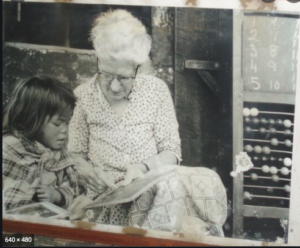
Margaret Barr (19 March 1899 – 11 August 1973), known as Annie Margaret Barr, was a British Unitarian minister who devoted her life to serving the indigenous Unitarian churches of Northeast India.
Born in the village of Menston, in the West Riding of Yorkshire, Annie Margaret Barr was the fourth of six children raised in a Wesleyan Methodist family. When she was ten, her father, Ninian Jaques Barr, an iron merchant, moved the family to nearby Leeds. When she was fifteen, the Great War began. Her eldest brother, named for their father, died in it. Another brother, Arthur, served as a junior chaplain and became a Methodist minister.
Margaret attended Girton College, Cambridge, and joined a student missionary group. After the war, she later wrote, young women were discouraged from expecting marriage, since so many men had died. One Sunday, a friend took her to the Unitarian chapel, where she heard the minister, Dr. Cyril Flower, speak of Hinduism with respect and understanding. After graduation, she took teacher training and taught in London before enrolling at Manchester College, Oxford, to prepare for the Unitarian ministry. She yearned to serve in a culture different from the one that had created the devastation of war.
By then her older sister, Mary, was teaching as a Methodist missionary in India. She made a visit to family in England in 1931. Margaret was serving the Unitarians of Rotherham, Yorkshire. Coincidently, Mohandas Gandhi was in London leading the Congress Party delegation to a conference on the governance of India. He and Mary returned to India aboard the same ship, forming a life-long friendship. When the British jailed Gandhi, Mary visited him, leading her Methodist employers to admonish her. She resigned from mission work and moved to Gandhi’s ashram in Ahmedabad, becoming a Gandhian worker in villages. Later, just after Gandhi’s assassination in 1949, Mary Barr published Bapu: Conversations and Correspondence with Mahatma Gandhi.
Margaret had learned of the indigenous Unitarian movement in the Khasi and Jaintia Hills of Northeast India. Its founder, Hajom Kissor Singh, had discovered Unitarianism and developed its worship life in partnership with an American Unitarian missionary and teacher in Calcutta, Charles H. A. Dall. In her later autobiography, A Dream Come True, Margaret felt a call to follow, saying, “Here I am; send me!” She felt that her training as both as a teacher and minister could be useful. The British Unitarians, still seeking someone to pursue the Northeast India project, demurred. “No committee would take the responsibility of sending a woman alone to such a lonely post,” they replied. Margaret Barr offered to find another woman to serve as “the minister’s wife,” but the friend she approached had her own career to consider. Margaret instead took a two-year post with the Gokhale School for Girls in Calcutta (Kolkata). She arrived in Bombay (Mumbai) alone, and was taken to the home of a wealthy woman jailed for activism, and then to Gandhi at Wardha. He admonished her to work in villages and stay out of jail. That message shaped her ministry.
“Victorian imperialism . . . still lives, crushing this land like the insatiable monster it is, and my loathing for it deepens in intensity with every day that I live here,” she wrote her mother in 1934. By then she was writing her first book The Great Unity. It was a curriculum for teaching those raised in differing traditions “to respect religions other than their own.” Her students often came from families in the liberal Hindu movement, the Brahmo Samaj. In 1934, the journey from Calcutta to the Khasi Hills began with a twelve-hour train ride north along the steamy Brahmaputra River to Guwahati, then south again before six hours of hairpin turns up to Shillong, 6000 feet above sea level, where she again found cool air reminiscent of Yorkshire. The highland region now known as the Indian state of Meghalaya had few Hindus. Indigenous tribal people of the Tibeto-Burman language group constituted roughly 90% of the population, among whom a similar percentage were converts to Christianity.
The indigenous leader of the Khasi Unitarians, Hajom Kissor Singh, had died in 1928, at age 58. He had previously suffered the death of his wife and most of their children. He had sent a son to study in the United States, who died there in 1923. By the time of his death, he led ten Unitarian congregations totaling about five hundred members. Margaret saw their needs and their devotion. She resolved to help them. She spent two years going between Calcutta and Shillong, finally winning support from British Unitarians as their representative. She then settled in Shillong as the best place from which to influence education among the Khasis, still largely conducted through mission churches. She loved trekking between the villages, carrying her own rucksack and refusing the carriers other Europeans used. She often walked barefoot because shoes impeded fording the many streams in the hills.
In 1937, Margaret undertook a harrowing trip back to England, via Malta and Belgium, to report to the General Assembly of Unitarian and Free Christian Churches, telling them that she was working for the self-reliance of the Unitarian movement in India, not its long-term dependency. The women’s organization decided to underwrite her salary. That continued until her retirement.
She had formed a partnership with Ellen Giri, “the most completely kindred spirit I have found among the Khasis.” Ellen had a child to raise after her husband left her. She taught physical education and joined Margaret in supporting Indian independence, which was a minority view among Khasis. Through Ellen, Margaret met Lady Reid, wife of the British governor of Assam, who helped them obtain government support for their educational work. They also cultivated connections with the Brahmo Sama and with Vedanta followers of Ramakrishna and his disciple, Vivekananda, who taught the unity of all religions. They had an ashram at Cherrapunji, high in the hills separating Meghalaya from Bangladesh.
In 1940, the Assam government asked Margaret to start a high school in Jowai. She accepted, with the understanding that she would continue to visit teachers in the villages. When the war caused funds to dry up, Margaret soon resigned but not before naming the school, built in 1942, for Lady Reid, who had returned to England that year. Margaret herself did so a year later, taking a ship around South Africa that had to dodge Nazi submarines. She returned in late 1944, saying, “In spite of the setback to my work caused by this long absence, and in spite of the many sleepless nights I spent in London while flying bombs and V2s zoomed overhead, I have never regretted this decision to throw in my lot with my country at that crisis in her history.”
Back in Shillong, she oversaw both a school for young children and the teacher training school, sending teachers to villages to provide free, non-proselytizing education. She struggled to obtain government funding. After Gandhi’s assassination, she felt called to live in a village, not a town. Following a fundraising tour overseas, in 1951 she established the Kharang Rural Center near a village roughly midway between Shillong and Jowai. This brought on a deep misunderstanding. Khasi Unitarians could not understand why she wanted to train teachers in an isolated setting. Few students came at first. She then attracted the assistance of young Unitarian student minister, Bruce Findlow (1922-1994), later the Principal of Unitarian College, Manchester, and the author of the hymn, “For All That Is Our Life’ (SLT #128). “In one of the loneliest and toughest jobs in the world,” he wrote, Margaret paid “practical tribute to Gandhiji who loved villagers and Kissor Singh who brought his people a religion of love [inspired others to] take the path which leads above and beyond any call of duty to a lifetime of unlimited love, expressed in unlimited work.”
Margaret wrote to the Unitarian General Assembly in Britain that among “Life’s Little Ironies” lay the fact they had denied her support unless she had a [preferably male] partner in her work, she had supported Findlow out of her personal funds and then been denied financial support for anyone to replace him. “After all,” she ended, “I have only one pair of hands –and feet.” She admitted that the Kharang Rural Centre had failed in its initial aim: it had not produced a single trained leader for any Khasi Unitarian church. She had also not inspired the Khasi Unitarians to take much interest in liberal religion beyond their own group, nor to become passionate leaders for social change in their region, nor to practice lively free inquiry and an understanding of religion as not so much a devotional practice as a way of life.
Findlow’s wife Mary came to stay at Kharang in 1954-55. She had been head matron of a hospital in Sydney, Australia. Together, they transformed the work there to be a women’s clinic. Margaret then left for England. Stopping in South Africa, where her parents had died, tended by her Methodist missionary brother, she learned of the sudden and unexpected death of Ellen Giri, “the most shattering blow that fate has ever dealt me, not only personally, but also to my hope and dreams for . . . Kharang.”
When she returned, she threw herself into the ongoing work there. With no other teachers, she trained middle school students to teach younger students, while she worked with older students to finish the high school curriculum. Almost all students passed their exams. In 1962, she took two female students to England for further study, then attended the UUA General Assembly in Chicago to receive its annual award for Distinguished Service to the Cause of Liberal Religion. She also visited Canada, where the Unitarian Service Committee of Canada had been helping to fund the Kharang Centre and thirty-four Canadian families had served as host parents for Khasi students. She also preached the annual sermon for the British General Assembly in Edinburgh.
At the end of 1963, parents in villages around Kharang came to her with plans to develop middle schools using her students as teachers, then to develop a high school. By the age of 70, in 1969, Margaret was exhausted and ill. She slipped and fell while hanging laundry and damaged an eye. Taken to the hospital at Shillong in a carrying chair requiring eight men, she spent four days hung between life and death. Hospitalized for most of that year, and knowing that she might not live long, she fretted over the future of her work in Kharang, corresponding with the General Secretary of the British Unitarian Association, Roy Smith. Her last trip to England in 1972 was to accompany her protégé Devison Marbaniang to England, where he was to speak at the General Assembly and where she was to undergo eye surgery. She spent 1973 writing an autobiography, noting that the Kharang Centre had served 50 students between 1951 and 1970. At the time of her death, the health clinic which had been built there served 20 surrounding villages. She died August 11, 1973, at the age of 74. The clinic there and a high school bear her name.
During the 1990s, the Unitarian Universalist Association, using discretionary funds from the Holdeen India Trusts, was able to revive support for the Unitarian Union of Northeast India, encouraging them to continue Margaret Barr’s advocacy for the government of India to provide more adequate funding for the education of children in poor and marginalized communities. American Unitarian Universalists Dee Idnani and Catie Scudera (later a UU minister) were able to fund, build and staff the A. Margaret Barr Children’s Village for orphaned children. The International Convocation of Unitarian Universalist Women (ICUUW) named its highest award for Margaret Barr.
She once wrote, “When I am anywhere else, the one thing I miss the most is the peace of my home in Khasi . . . Just because you are solitary does not mean you are lonely . . . Where children are there is a world of difficulties, triumphs, defeats, warnings, worries – but mainly there is love and its warmth.”
Sources
Margaret Barr, A Dream Come True (1974); The Great Unity, 1937; Barr, et al. Margaret Barr: A Universal Soul. Ed. Y. Surrendra Paul (1975); Bruce Findlow, Kharang (1955); Mary Lawrence, “Khublei,” The Story of the Khasi Hills Liberal Churches (1964). For additional information see Mary Barr, Bapu: Conversations and Correspondence with Mahatma Gandhi, 2nd ed. (1956); Archive MS. 1-5, Harris Manchester College, Oxford, England; Thomas Weber, Going Native: Gandhi’s Relationship with Western Women (2011); and Annie Woodhouse, “A Visit to the Unitarians of the Khasi Hills” (1930), also in the Harris Manchester Archives.
Article by Laura Vogel
Published June 4, 2026