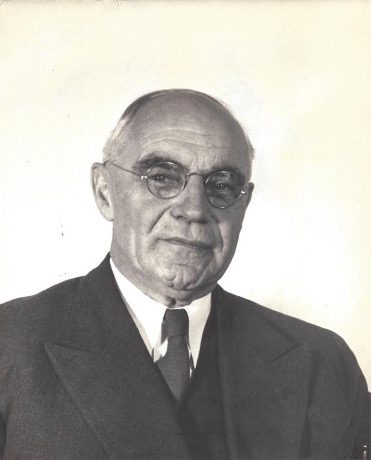
 Earl Clement Davis (June 3, 1876 – May 19, 1953) was Unitarian minister of the first half of the twentieth century who understood modern life as requiring freedom, discovery , and consent. He ran for public office as a Socialist. He vigorously supported congregational polity and opposed any religious creed or over-sight of an individual’s religious thinking. He promoted scientific discovery and American government as based on the consent of the governed. He wrote insightfully about the challenges of pastoral leadership while maintaining one’s intellectual and moral integrity. He served at Unity Church, Pittsfield, MA, 1905-1919; Church of Our Father, Lancaster, PA, 1919-1924; Unitarian Church of Concord, NH, 1924-1933; and First Parish Church (Unitarian) of Petersham, MA, 1933-1953. It was as minister of the Petersham village church that he found true joy. Davis Memorial Hall, built following his death as an annex, is a tribute to him as the beloved pastor there for twenty years.
Davis was born in Auburn, Maine and grew up moving between his parents’ home in Auburn and his uncle’s farm in Poland, Maine. He attended Bowdoin College, graduating in 1897. From there he was hired as the principal of the public high school—the Howe School—in Billerica, Massachusetts. The town had a population of 2775 according to the 1900 census. Davis served in this role for five years, 1897-1902. He boarded in the home of a local widow, Mrs. Annie Whitney Dodge. Her eldest daughter, Annie Foster Dodge, graduated at 18 from the Howe School. Her diploma was signed by the new young principal, Earl Davis, age 22. They became romantically involved and “an understanding” was established. She attended the Lowell Normal School (now the University of Massachusetts Lowell) and earned her teaching certificate in 1900. She then took a teaching job in Merrimack, Massachusetts. They waited to marry until Davis was settled in his new profession as a minister.
In applying to become a Unitarian minister, Davis described his religious upbringing as “somewhat Methodist.” When he arrived in Billerica, the new minister of the First Parish (Unitarian) was Minot Simons (1868-1941), a recent graduate of Harvard Divinity School, and an enthusiast for liberal religion. The retiring principal of the Howe School, Samuel Tucker, had developed a decades-long close personal and professional relationship with Simons’ deceased predecessor, Christopher Coffin Hussey (1820-1897). A relationship between the new young principal and young Minot Simons was therefore natural. Still pondering his future, Davis took a graduate course at the Harvard School of Education during the 1899-1900 academic year. Ultimately, he opted for the ministry, and in the fall of 1902, he enrolled full-time at Harvard Divinity School. He gave his first sermon as a lay preacher on July 21, 1901, at the Congregational Church in Freeport, Maine, on “The Church as a Social Institution.”
Davis graduated from the Divinity School in 1904 with the degree Bachelor of Sacred Theology. Unitarian theologian William Wallace Fenn (1862-1932) was one of Davis’s teachers. Davis was one of “Fenn’s boys,” as Charles E. Park (1873-1962) described them in his 1932 memorial address after Fenn’s death, “They were very dear to him, and he was very dear to them.” In this same volume of memorial essays, Davis contributed the “Alumni Tribute.” Another of Fenn’s boys, John Haynes Holmes (1879-1964), also graduated in 1904 and he and Davis maintained a life-long friendship.
Davis was called to his first ministry at the Unity Church in Pittsfield, Massachusetts in 1905. This move further cemented his connection to William Wallace Fenn, for in 1887 Fenn was the founding minister of the Unity Church. Davis was ordained there on April 7, 1905. Degree and full-time employment in hand, Davis married Annie Foster Dodge on June 28, 1905. Her mother and two sisters moved to Pittsfield to join the household as Davis took up his ministry. Their first child, John, was born in 1906, followed by Foster in 1908, Byron in 1912, and Mary in 1915.
Early during his time in Pittsfield Davis gained national notoriety for refusing that portion of his salary generated by church suppers and other fundraisers. Davis was widely quoted in newspapers nationally as saying, “Church suppers for revenue, as they are usually conducted, are a light form of graft. The sale of tickets for such suppers and fairs to those who really don’t want them is a sort of blackmail.” To replace the lost income, Davis “moonlighted” at various industrial concerns, including the local General Electric Plant, where he was able to recruit new members for his congregation.
Davis was an active member of the Socialist Party while in Pittsfield. In 1911 he ran for Alderman on the Socialist ticket. He lost but told the Berkshire Eagle that he and his fellow socialists were nonetheless pleased with the 550 votes he received, as fairly representing “the number of voters who are sufficiently advanced in their political thinking,” and quite confident that there would be “a gradual and steady growth” in socialist support (see the Berkshire Eagle, December 13, 1911, p. 9). Many of his sermons and other writings from this period dealt with social and political concerns, always from a Socialist viewpoint. Unlike his friend John Haynes Holmes, Davis was not a pacifist. While the U.S. Socialist Party opposed America’s entry into World War I, Davis served as Chairman of the Board of Instruction of the Pittsfield Draft Board. He spent five months at Camp Devens in Ayer, Massachusetts, providing religious support for troop training there to serve in the army.
As the war concluded, workers at the General Electric plant in Pittsfield went on strike. Davis, trusted as a “straight-shooter,” with the agreement and support of both the workers and the owners, was engaged by War Labor Board to oversee the administration of an agreement that ended the strike.
In 1919, after 14 years in Pittsfield, he accepted a call to the Unitarian Church of Our Father in Lancaster, Pennsylvania. Three years later, he wrote to his friend Minot Simons, by then Secretary of the Church Extension Department of the American Unitarian Association, that he had found the Pittsfield church “a very hard job,” one that “took out of me something, or gave me something, I know not which, that has created in me a desire, very strong indeed, for another sort of parish.” He did not want to leave Lancaster precipitously, however, where his relations with the congregation were “going in a satisfactory manner.” Still, he knew what he really wanted in a parish.
In a review of a 1921 New Republic article by Lewis Lowry, “The Plight of the Thinking Minister,” Davis discussed the challenge of alignment between a minister’s views and those of his parish. The problem, he felt, could be put rather succinctly: “Conform or get out.”
He employed a metaphor taken from evolutionary biology. New variants, including new ways of thinking, must contend against entrenched interests of established ways of thinking. The dilemma of the minister who advocates new ways of thinking lies in creating friction with entrenched interests and conservative elements in the parish while also maintaining absolute integrity and candor in religious and moral matters.
“Into such a changing set of institutions the minister enters, having chosen as a life work to become an educator, a moral leader. Many are the requirements demanded of this chosen field of work, but the keystone in the arch of his equipment is that of moral and intellectual integrity. He may be conservative or liberal; he may be a great scholar or not; he may be genial and a good mixer; or he may be reserved and diffident; but he must be a man of integrity and courage. There can be no compromise on this point.”
When a congregation’s “spirit, purpose and standards” don’t match those of the minister, “the cards must be laid on the table. The church involved has its integrities at stake as well as the minister. The minister is not always right. He can hardly expect a church to sacrifice what it considers an important principle any more than the church should expect him to side-step the clear implications of his convictions. The understanding between a minister and the church with which he is associated should be clear and unmistakable. The relations may not always be free from ruffling disturbances, but there can be no playing fast and loose. … Unless such a clear and above-board understanding can obtain the minister is bound, both in obligation to himself and to social institutions, to follow the lead of his convictions whether churches collapse or not. … A price must be paid for nonconformity even in our tumultuous fascinating generation.” In some respects, these thoughts were prophetic of his next posting.
In 1924 he left the Church of Our Father to take the ministry of the Second Congregational Church (Unitarian) of Concord, New Hampshire, the capital of the state. His friend and teacher William Wallace Fenn gave the sermon at his installation on March 9, 1924.
Along with the ministry of the Concord Church Davis served as the Executive Secretary of the New Hampshire Unitarian Association. He was the Minister-at-large for the Downing Fund of New Hampshire, which provided outreach ministry throughout the state. New Hampshire Unitarians also sponsored Proctor Academy, a preparatory school in Andover, New Hampshire. Davis served as the President of the Board of Trustees of the Academy during his time in Concord.
By late 1932 challenging issues arose in his Concord ministry. The Great Depression hit liberal religious institutions hard. Nearly a third of all Unitarian churches closed their doors. In February 1933 Charles R. Joy (1885-1978), then Vice-President of the American Unitarian Association, wrote in a memo to the Administrative Council, “Earl Davis tells me that he must find another place before the first of September. I did not ask him what had happened at Concord but evidently the parish has told him that his ministry should terminate by that time.” The Concord church stood close to the Concond rail station. Davis allowed itinerant “hobos” to shelter in the church building. This likely did not sit well with all congregants. Davis expressed a preference for the First Congregational Church (Unitarian) in Petersham, Massachusetts. Charles E. Park, minister of the First Church of Boston, gave the sermon at Davis’s installation there on September 10, 1933.
As the Great Depression deepened the Unitarian denomination was in the throes of an intense self-examination, led by a Commission on Appraisal. Davis had a role as President of the Christian Register, the denomination’s periodical. In 1934 Davis gave a conference presentation, “The Next Step for Our Unitarian Churches.” Building on a heritage of following “truth in the fellowship of freedom,” he called for “investigation, discovery, and integrity.” He hoped both individuals and all Unitarian churches would, through investigation and integrity, “glow with the light and power that shall discover the answers that a disillusioned age is asking.” In November 1935, he ran a conference round table on “Centralization of Denominational Government: Do We Need More or Less?” Recognizing the strong tendency toward central authority in industry, state and church, he argued for resistance to any usurpation of local control.
In 1936, he co-authored a paper, “Democracy Versus Authority in Church (and State),” with Carl Heath Kopf (1902-1958), then the minister of a Congregational church in Boston. Again he insisted that “the future is with freedom, discovery and consent. … Within the field of religion and values, as elsewhere, the principles of freedom and fellowship, tested in experience, are valid guides to which complete allegiance may be given.” Modernity moves aside medieval culture as discovery displaces revelation; freedom challenges authority; and consent replaces obedience. This is how he understood modernity in religion and the value of congregational polity.
Yet in his zeal for modernity, Davis was no urbanist. He was personally more comfortable in smaller communities. The “massification” of modern culture was not of interest to him. Back in 1916 he and his wife had taken a summer vacation on Swan Island in Maine’s Kennebec River. It was a lovely, utopian place. Local fish, shad, were caught there and provided to Boston restaurants. Even then, Davis wrote in a little essay, he preferred life at the origin of the shad to where it was going: “the city with its hurry, and its pressure, its loss of the poise and dignity of life in the senseless round of activity.” Ironically, shortly after his 1916 summer visit the shad fishery collapsed and Swan Island lost its last permanent residents. It was no longer viable economically as a community.
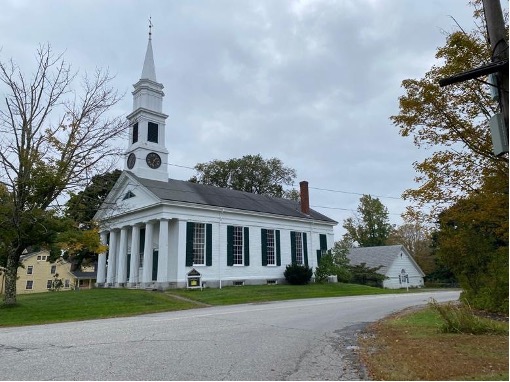
In Petersham, Davis worked diligently to keep not only the church, but the village, lively. During the Depression, he founded the Petersham Handicraft Society (still active in 2026) to help residents earn extra income. As an avid gardener, he planted and tended a large crop of vegetables each year. It was said that with his garden he helped the village stay well fed throughout the Depression. He served as President of the Petersham Memorial Library and of the Village Improvement Society. When war came again, he was chair of the local branch of the National War Fund Council, a member of the local Farm War Council and of the Timber Salvage Committee.
In 1944 the Christian Register ran a series of articles on churches in different settings. Davis contributed an article on the village church, writing that the “village church—the buildings and all the imponderable associations—becomes both a symbol and the witness of a faith, imperfect and somewhat vague perhaps, that our human lives, even amid the wrecked harvest of a tragic era, are the fertile seeds that promise the harvest of a better age to come. This irresistible momentum of human life, call it the spirit of God in the soul of man if you wish, registers in some human lives as a compelling conviction that has been the cloud by day and the pillar of fire by night in the long trek through history.” The chief function of any church, he felt, was to be found in the degree to which it instilled what he called “the spirit of God in the soul of man.” It was about helping people to see themselves as part of the long progressive development of life, helping them to take a part in making things better for future generations. Action for a better world was the goal.
For Davis the village church was intimate: “in addition to the imponderable changes that the war is producing” a village church feels “in a very intimate way the impact of those forces upon persons and homes: ten per cent of the population in service; forty names of men and women on the Honor Roll of one village church; almost every available man and woman at work in factories. ‘Lloyd was in the battle of Bougainville;’ ‘Roger is in Italy;’ ‘Horace sent a cable from England;’ ‘Arthur is in Alaska;’ ‘Charles received a D.S.C. in New Guinea;’ ‘Herbert goes tomorrow’—members of the village church; they sang in the choir, went to the church school, danced at the socials. They are our boys—flesh of our flesh, spirit of our spirit.”
The fact that villagers lived “close to the land” provided them vital insights. “We meditate upon the exacting process of which human beings are at once products and transmitting agents—first the blade, then the ear, and then the fertile grain in the ear. Just how we may not know, but the fertile fruit of the past contains the promise of harvests to come.”
Davis suffered a lengthy battle with intestinal cancer before he died on May 19, 1953. His closest ministerial friend, Charles E. Park, Minister Emeritus of the First Church of Boston, gave the eulogy to a Petersham church packed full, “not a seat to be had, townspeople, outsiders, many from Boston.” Park declared that “what Emerson said of Abraham Lincoln is another of those sayings we think of in connection with Mr. Davis: His heart was as wide as the world, but there was no room in it for a single unkind thought. And the consequence was that he habitually lived in a world that was peopled by noble women, and by men for whom he had his favorite expression, royal good fellow.”
“Just by being himself, Mr. Davis made the whole town a better, a sweeter, a happier place… He was as clear as crystal. His mercy was as plain as the day. His honor was as hard as stone… For twenty years Petersham has enjoyed the ennobling experience of being loved by one who was true to his God, and true to his fellowmen, and true to himself.
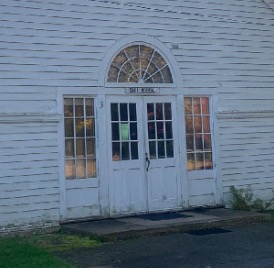
After his death the congregation launched an appeal for donations to build a parish hall. “Davis Memorial Hall” was built adjacent to the church where it stands today. Davis had found a “parish such as I want” where there was an alignment between his approach to religion and that of his congregation.
Article by Davis Baird
Published August 13, 2026
Sources: The Earl C. Davis Papers, Goddard Library of Clark University, digitally archived at https://commons.clarku.edu/earl_davis/